A Practical Guide to Troubleshooting SCF Convergence in Computational Chemistry
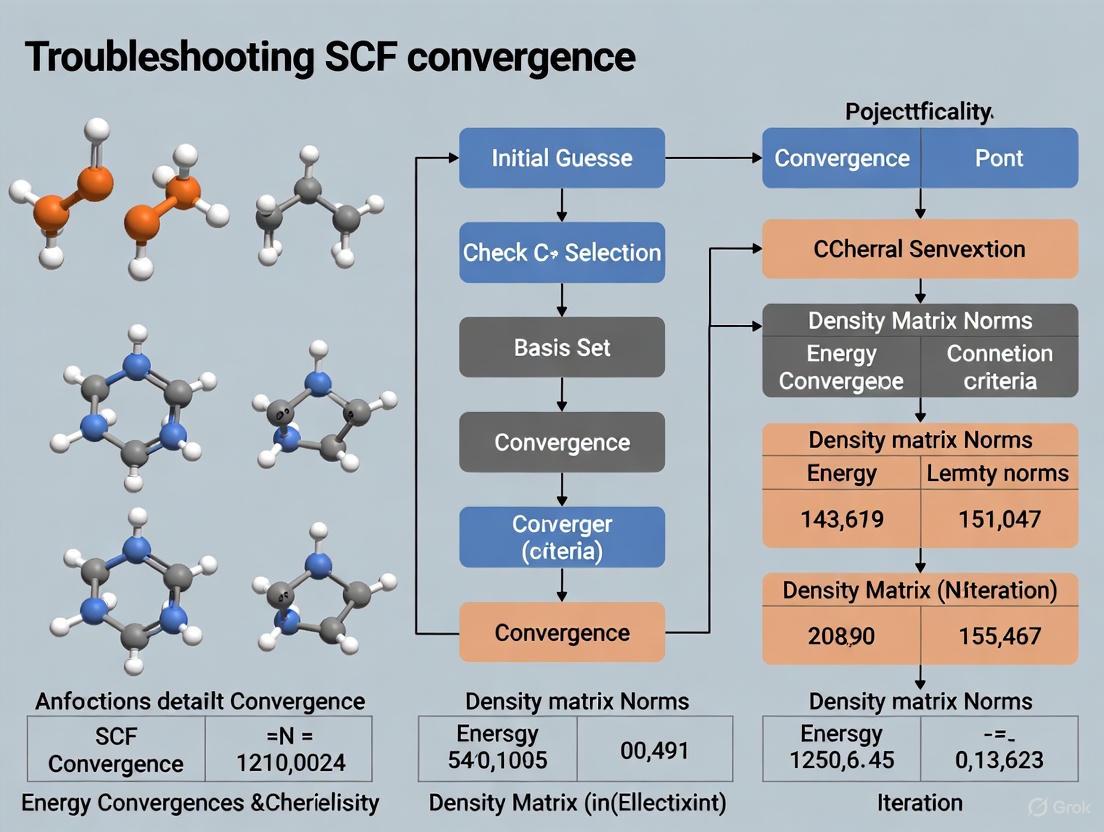
Self-Consistent Field (SCF) convergence is a fundamental yet often challenging step in computational chemistry calculations, directly impacting the reliability of results in drug design and materials science.
A Practical Guide to Troubleshooting SCF Convergence in Computational Chemistry
Abstract
Self-Consistent Field (SCF) convergence is a fundamental yet often challenging step in computational chemistry calculations, directly impacting the reliability of results in drug design and materials science. This article provides a comprehensive guide for researchers and development professionals, covering the foundational theory of SCF procedures, core methodological approaches for standard and difficult cases, systematic troubleshooting protocols for optimization, and validation techniques to ensure result accuracy. By integrating traditional strategies with insights into emerging machine learning methods, this guide offers a actionable framework for achieving robust SCF convergence in diverse chemical systems, from biomolecules to transition metal complexes.
Understanding SCF Convergence: Core Principles and Common Pitfalls
The Roothaan-Hall Equations and the SCF Iterative Process
Frequently Asked Questions (FAQs)
1. What are the Roothaan-Hall Equations? The Roothaan-Hall equations provide a matrix representation of the Hartree-Fock equations, making them solvable for molecules using standard matrix techniques with a finite basis set. They are expressed as FC = SCε, where F is the Fock matrix, C is the matrix of molecular orbital coefficients, S is the overlap matrix of the basis functions, and ε is a diagonal matrix of orbital energies. This formulation is fundamental to most ab initio quantum chemistry software [1] [2].
2. Why does my SCF calculation oscillate and fail to converge? SCF non-convergence often manifests as oscillations in the total energy. Common physical and numerical reasons include:
- Small HOMO-LUMO Gap: This can cause "charge sloshing," where the electron density oscillates between iterations, or even changes in orbital occupation numbers [3].
- Poor Initial Guess: An inaccurate starting density or set of orbitals can lead the SCF procedure down a divergent path. This is particularly common for systems with unusual charge, spin states, or metal centers [4] [3].
- Numerical Instabilities: Insufficient integration grid quality, loose integral cutoffs, or a near-linearly dependent basis set can introduce noise that prevents convergence [5] [3].
- Unphysical Molecular Geometry: A geometry that does not make chemical sense (e.g., atoms too close or bonds overly stretched) can create convergence difficulties [5] [3].
3. What is the difference between 'near convergence' and 'no convergence' in ORCA? Since ORCA 4.0, the behavior after SCF non-convergence has been made more strict to prevent the use of unreliable results.
- Near SCF Convergence is defined as: deltaE < 3e-3; MaxP < 1e-2; and RMSP < 1e-3. In a single-point calculation, ORCA will stop but in a geometry optimization, it may continue, hoping convergence improves in later cycles [5].
- No SCF Convergence occurs when the above thresholds are exceeded. ORCA will stop all calculations, including geometry optimizations [5].
You can modify this behavior using the
SCFConvergenceForcedkeyword or the%scf ConvForced true endblock [5].
4. My system has a small HOMO-LUMO gap. What SCF strategies can help? Systems with small gaps, like conjugated molecules or metal complexes, are notoriously difficult. Effective strategies include:
- Level Shifting: Artificially increasing the energy gap between occupied and virtual orbitals to stabilize the orbital updates [4].
- Fractional Occupations / Smearing: Allowing fractional orbital occupancies based on orbital energies can help achieve convergence for small-gap systems [4].
- Damping: Mixing a portion of the previous iteration's Fock/density matrix with the new one to dampen oscillations [4].
- Advanced Algorithms: Using robust but expensive second-order convergence methods like TRAH (Trust Radius Augmented Hessian) in ORCA or the SOSCF (Second-Order SCF) method in PySCF [5] [4].
5. How can a poor geometry cause SCF convergence problems? An unreasonable geometry is a common root cause. Too-long bonds can lead to a small HOMO-LUMO gap, while too-short bonds can cause basis set linear dependency issues. Both scenarios make the SCF problem numerically unstable [3]. Always check your starting geometry for chemical reasonableness.
Troubleshooting Guide: Resolving SCF Convergence Failures
This guide provides a structured approach to diagnosing and fixing SCF convergence issues.
Step 1: Initial Diagnosis and Simple Fixes
- Check the Geometry: Verify that your molecular coordinates are sensible and in the correct units (e.g., Ångströms vs. Bohr) [3].
- Increase Maximum Iterations: If the SCF is slowly converging and is close to the default iteration limit (e.g., 125 in ORCA), simply increasing this limit can help.
- ORCA Example:
%scf MaxIter 500 end[5].
- ORCA Example:
- Improve the Initial Guess: A better starting point can often resolve convergence problems.
- Use a Simpler Method: Converge a calculation with a cheaper method (e.g., HF or a semi-empirical method) and use its orbitals as a guess for the target calculation [5] [4].
- Try Alternative Guess Algorithms: Switch from the default guess to
Huckel,Atom, or other available methods in your code [4]. - Oxidized/Reduced State Guess: For open-shell transition metal complexes, try converging a closed-shell ionized state first and use its orbitals as the guess [5].
Step 2: Employing Convergence Accelerators and Stabilizers
If simple fixes fail, the following techniques can be employed, often in combination. The table below summarizes key "research reagents" – the computational tools at your disposal.
Table: Research Reagent Solutions for SCF Convergence
| Reagent / Method | Function | Typical Use Case |
|---|---|---|
| DIIS (Direct Inversion in Iterative Subspace) | Extrapolates a new Fock matrix from previous iterations to accelerate convergence [4]. | Standard, well-behaved systems. The default in many codes. |
| Damping | Mixes the new Fock/density matrix with that from the previous iteration to suppress oscillations [4]. | Wild oscillations in early SCF iterations. |
| Level Shifting | Increases the energy of virtual orbitals, stabilizing the update of molecular orbitals [4]. | Systems with a small HOMO-LUMO gap. |
| SOSCF (Second-Order SCF) | Uses second-order convergence algorithms (e.g., Newton-Raphson) for quadratic convergence near the solution [5] [4]. | When DIIS trails off or fails. Often default for RHF but not UHF. |
| TRAH (Trust Region Augmented Hessian) | A robust second-order converger that activates automatically in ORCA when DIIS struggles [5]. | Pathological cases; metal clusters, open-shell systems. |
| Fractional Occupancy / Smearing | Assigns fractional electron occupation to orbitals near the Fermi level [4]. | Metallic systems or those with a very small HOMO-LUMO gap. |
Implementation Examples:
- Enabling Damping and Level Shift in PySCF:
- Using SOSCF in PySCF:
- Using Slow Convergence Keywords in ORCA:
Step 3: Advanced Protocols for Pathological Cases
For truly difficult systems (e.g., open-shell transition metal complexes, iron-sulfur clusters, or radical anions with diffuse functions), more aggressive measures are required.
Protocol 1: Converging Open-Shell Transition Metal Complexes in ORCA This protocol combines strong damping and a large DIIS subspace [5].
- Keyword: Use
! SlowConvor! VerySlowConvto enable stronger damping. - SCF Settings:
- Alternative Algorithm: Try the KDIIS algorithm, sometimes with delayed SOSCF:
! KDIIS SOSCFand%scf SOSCFStart 0.00033 end[5].
Protocol 2: Addressing Linear Dependence in Large/Diffuse Basis Sets
This issue is common with basis sets like aug-cc-pVTZ [5] [6].
- Diagnosis: The calculation may abort with an error about a "dependent basis."
- Solution: Do not simply loosen the linear dependency criterion. Instead, remove the most diffuse basis functions or employ atomic confinement potentials to reduce the range of the basis functions, thereby eliminating the linear dependency [6].
The following workflow diagram summarizes the logical relationship between the troubleshooting steps described in this guide.
Frequently Asked Questions (FAQs)
Q1: What are the most common physical reasons for SCF convergence failure? The most common physical reasons are directly related to the electronic structure of the system being studied [7] [3]:
- Small HOMO-LUMO Gap: Systems with nearly degenerate frontier orbitals (e.g., metallic systems, large conjugated molecules, or transition states) are prone to convergence issues. This can cause electrons to oscillate between orbitals or lead to "charge sloshing," where the electron density fluctuates wildly between iterations [3].
- Open-Shell Systems: Transition metal complexes and radicals with localized open-shell configurations are notoriously difficult to converge due to the presence of multiple, nearly degenerate electronic states [7] [5].
- Non-Physical Geometries: Calculations starting from unrealistic molecular geometries, such as those with excessively long or short bonds, often fail. Stretched bonds can create a small HOMO-LUMO gap, while compressed bonds can lead to basis set linear dependence [7] [3].
Q2: My calculation is oscillating between two energy values. What does this mean and how can I fix it? An oscillating SCF energy is a classic sign of a small HOMO-LUMO gap causing electrons to swap between nearly degenerate orbitals in successive iterations [3]. To address this:
- Apply Level Shifting: Artificially raising the energy of the virtual orbitals (e.g.,
SCF=vshift=300in Gaussian) can stabilize the convergence by reducing mixing between occupied and virtual orbitals [8]. - Use Damping: Reducing the mixing parameter (e.g.,
Mixing 0.015in ADF) uses less of the new Fock matrix in each cycle, leading to slower but more stable convergence [7]. - Employ Electron Smearing: Using a finite electron temperature (Fermi broadening) allows for fractional orbital occupations, which can help systems with near-degeneracies find the correct solution path [7] [8].
Q3: I am studying a transition metal complex. Why does the SCF fail and what strategies are recommended? Open-shell transition metal complexes are challenging due to localized d- or f-electrons and often multiple low-lying electronic states [7] [5]. Specialized SCF procedures are often required:
- Use Specialized Keywords: In ORCA, keywords like
SlowConvorVerySlowConvapply stronger damping to control large initial fluctuations [5]. - Increase DIIS Memory: Using more DIIS expansion vectors (e.g.,
DIISMaxEq 15in ORCA) makes the extrapolation more stable for difficult cases [7] [5]. - Change the Initial Guess: Calculate a closed-shell ion of the system or use a simpler method (e.g., BP86/def2-SVP), then read the converged orbitals as a guess for the target calculation using
guess=readorMORead[5] [8].
Q4: What numerical issues can cause SCF failure, even for seemingly simple molecules? Numerical problems can destabilize the SCF process [3]:
- Linear Dependence in the Basis Set: Large or diffuse basis sets (e.g., aug-cc-pVQZ) can become nearly linearly dependent, making the Fock matrix ill-conditioned.
- Insufficient Integration Grid: For DFT calculations with certain functionals (like the Minnesota series), a default integration grid may be too coarse, introducing numerical noise. Using an ultrafine grid often helps [8].
- Inaccurate Integral Evaluation: Approximate integral evaluation schemes (like "Incremental Fock" in Gaussian) can speed up calculations but may hinder convergence. Turning them off (
SCF=NoIncFock) can restore stability [8].
Troubleshooting Guide: A Systematic Approach
This section provides a step-by-step methodology for diagnosing and resolving SCF convergence problems.
Step 1: Preliminary Checks Before adjusting advanced parameters, always verify the fundamentals [7] [9]:
- Geometry: Ensure bond lengths and angles are chemically sensible and the correct units (e.g., Ångström) are used.
- Spin and Charge: Confirm the molecular charge and spin multiplicity are correctly specified.
- Basis Set: Check that the basis set is appropriate for all atoms, especially metals and heavy elements.
Step 2: Analyze the SCF Output Examine the SCF iteration energy and error reports. The pattern provides critical diagnostic information [3]:
| Observation Pattern | Probable Cause | Initial Action |
|---|---|---|
| Convergence is slow but steady | Poor initial guess or a difficult but stable system. | Increase MaxIter and restart from the last orbitals [5]. |
| Wild oscillations in energy/error | Small HOMO-LUMO gap, "charge sloshing." | Enable damping or level shifting [7] [8]. |
| Convergence "trails off" and stops | DIIS algorithm is stuck. | Switch to a second-order convergence algorithm (e.g., SOSCF, NRSCF, TRAH) [5]. |
| Oscillations with very small amplitude | Numerical noise from integration grid or approximations. | Use a finer integration grid or disable approximate Fock builds [3] [8]. |
Step 3: Implement Advanced Protocols If preliminary steps fail, apply these targeted protocols.
Protocol A: For Systems with a Small HOMO-LUMO Gap
- Method 1: Level Shifting
- Method 2: Electron Smearing (Fermi Broadening)
Protocol B: For Difficult Open-Shell and Transition Metal Systems
- Method 1: Aggressive Damping and Large DIIS
- Method 2: Second-Order Convergence Algorithms
- Principle: Uses more sophisticated algorithms (like TRAH in ORCA) that are robust but computationally more expensive [5].
- Implementation (ORCA): TRAH activates automatically in difficult cases. It can be controlled via:
Protocol C: For Numerical Instability and Linear Dependence
- Method 1: Improve Numerical Integration
- Principle: A finer grid reduces noise in the Fock matrix construction [8].
- Implementation (Gaussian):
# int=ultrafine
- Method 2: Disable Approximate Algorithms
The following workflow diagram summarizes the systematic troubleshooting process:
The Scientist's Toolkit: Research Reagent Solutions
This table lists key computational "reagents" and their functions for tackling SCF convergence problems.
| Tool / Reagent | Function & Purpose | Key Considerations |
|---|---|---|
| Level Shift | Artificially increases virtual orbital energies to widen HOMO-LUMO gap [8]. | Does not affect final energy; ideal for single-point calculations. May give incorrect virtual orbital properties [7]. |
| Electron Smearing (Fermi) | Uses fractional occupations to resolve near-degenerate states [7] [8]. | Alters total energy; must be used cautiously and removed for final energy evaluation [7]. |
| DIIS (Direct Inversion in Iterative Subspace) | Extrapolates a new Fock matrix using information from previous cycles to accelerate convergence [7]. | Default in many codes. Can be destabilizing; increasing the number of vectors (N) can improve stability [7] [5]. |
| Damping | Uses only a small fraction of the new Fock matrix to ensure stable, slow convergence [7]. | Controlled by the "Mixing" parameter. Lower values (e.g., 0.01-0.05) are more stable [7]. |
| Second-Order Convergers (SOSCF, TRAH) | Uses Hessian information for more robust convergence, especially when DIIS fails [5]. | Computationally more expensive per iteration but can converge in far fewer steps for pathological cases [5]. |
| Ultrafine Integration Grid | Increases the number of points for numerical integration in DFT, reducing numerical noise [8]. | Essential for Minnesota functionals (M06-2X, etc.) and systems with diffuse functions [8]. |
This guide helps you diagnose and resolve common Self-Consistent Field (SCF) convergence issues in computational chemistry calculations.
Frequently Asked Questions
Q1: What does it mean when my SCF calculation oscillates? Oscillation often occurs when frontier orbitals are very close in energy (small HOMO-LUMO gap), causing electrons to repeatedly move between them. This creates a cycle where the density matrix and Fock matrix fail to settle. The energy may oscillate between two or more values with a significant amplitude (e.g., 10⁻⁴ to 1 Hartree). This is sometimes called "charge sloshing," where a small error in the Kohn-Sham potential causes a large density distortion [3].
Q2: Why does my calculation converge very slowly or "trail off"? Slow convergence manifests as steady but minute changes in energy over many iterations. Common causes include an inadequate initial guess, numerical noise from integration grids or integral cutoffs, or a system that is inherently difficult to converge, such as open-shell transition metal complexes or systems with dissociating bonds [5] [3] [7].
Q3: What does "failure to locate stationary point" indicate? This error in geometry optimizations often signals that the SCF procedure failed to converge for one or more points along the optimization path. The underlying cause can be an unreasonable molecular geometry (e.g., bond lengths that are too long or short), an incorrect electronic structure description (wrong spin multiplicity), or a fundamental SCF convergence problem at a specific geometry [9] [7] [10].
Diagnostic Table: Identifying SCF Convergence Problems
The table below will help you diagnose the specific nature of your SCF convergence issue.
| Observed Problem | Common Root Causes | Typical Signatures in Output |
|---|---|---|
| Oscillation | Small HOMO-LUMO gap, leading to alternating orbital occupation or charge sloshing [3]. | Total energy oscillates with significant amplitude (e.g., 10⁻⁴ to 1 Hartree); occupation numbers of frontier orbitals may change between iterations [3]. |
| Slow Convergence | Poor initial guess, numerical inaccuracies (loose integral thresholds, coarse grid), inherently difficult systems (e.g., open-shell transition metals) [5] [3]. | Steady but very slow decrease in energy change (Delta E) and density error; many iterations with little progress [5]. |
| Stationary Point Issues (in Geometry Optimization) | SCF failure at a specific geometry; unrealistic starting geometry; incorrect spin state; forces are inaccurate due to poor SCF convergence [9] [10]. | "Failure to locate stationary point" or "SCF has not converged" error; energy may oscillate or not decrease meaningfully during optimization cycles [9]. |
Experimental Protocols for Resolution
Protocol 1: Generating an Improved Initial Guess
A robust initial guess is critical for SCF convergence.
- Converge a Simpler Calculation: First, run a calculation using a lower-level method (e.g., HF or a semi-empirical method) and/or a smaller basis set (e.g., def2-SVP) [5] [11].
- Read Orbitals: Use the converged orbitals from this simpler calculation as the initial guess for your target calculation. In many codes, this is done via keywords like
MOReadin ORCA orguess=readin Gaussian [5]. - Alternative: For open-shell systems, try converging the corresponding closed-shell ion first, then use its orbitals as the starting point for the neutral open-shell system [5] [11].
Protocol 2: Systematically Adjusting SCF Algorithm Parameters
If a better guess does not suffice, adjust the SCF procedure itself.
- Increase Maximum Iterations: For slow but steady convergence, simply increase
MaxIter(e.g., to 500) [5]. - Enable Damping/Level Shifting: For oscillating systems, use damping (mixing a fraction of the old density with the new) or level shifting (artificially raising the energy of virtual orbitals) to stabilize the early iterations [9] [7]. Keywords like
SlowConvin ORCA often enable this [5]. - Modify the DIIS Algorithm: For difficult cases, increase the number of previous Fock matrices used in the DIIS extrapolation (
DIISMaxEqorNin DIIS settings). Values of 15-40 can be more stable than the default [5] [7]. - Use a Robust Converger: If the standard DIIS fails, activate more powerful algorithms like the Trust Radius Augmented Hessian (TRAH) in ORCA or quadratic convergence (QC) in Gaussian [5] [11].
Protocol 3: Checking and Correcting the Physical Model
Ensure the problem setup is physically sound.
- Verify Geometry: Check that all bond lengths and angles are reasonable. A geometry that is physically unrealistic is a common source of convergence failure [7] [10].
- Confirm Spin and Charge: Ensure the specified charge and spin multiplicity are correct for your system [7].
- Inspect the Basis Set: Very large or diffuse basis sets can sometimes cause numerical problems or near-linear dependencies, hindering convergence [5] [3].
SCF Convergence Troubleshooting Workflow
The Scientist's Toolkit: Research Reagent Solutions
| Tool / 'Reagent' | Function in Convergence | Application Notes |
|---|---|---|
| Improved Initial Guess | Provides a starting point closer to the final solution, reducing iterations needed. | Use MORead or guess=read to import orbitals from a lower-level calculation [5]. |
| Damping / Mixing | Stabilizes oscillation by blending old and new density matrices. | A lower mixing parameter (e.g., 0.015) increases stability for difficult cases [7]. |
| Level Shifting | Artificial separation of orbital energies to prevent oscillation. | Can help but may give incorrect properties involving virtual orbitals [7]. |
| DIIS (DIISMaxEq/N) | Extrapolates a better new guess using information from previous cycles. | Increase to 15-40 for harder systems; more stable but uses more memory [5] [7]. |
| TRAH / QC Algorithms | Robust, second-order convergence methods. | More reliable but slower than DIIS; use when other methods fail [5] [11]. |
The Role of Basis Sets and Initial Guesses in SCF Stability
Frequently Asked Questions
Why is the initial guess so critical for SCF convergence? The initial guess for the molecular orbitals places the SCF procedure in a specific region of the wavefunction space. A poor guess can lead to slow convergence, a complete failure to converge, or convergence to an unintended electronic state (like an excited state) rather than the ground state [12]. A high-quality guess that is close to the final solution can significantly reduce computation time [12].
My calculation for an open-shell transition metal complex won't converge. What should I check first? Open-shell transition metal compounds are notoriously difficult to converge [5]. First, ensure the geometry is reasonable and the correct spin multiplicity is set [7]. Then, focus on the initial guess; try using the
Superposition of Atomic Densities (SAD)guess or reading in orbitals from a converged calculation of a simpler method (like BP86/def2-SVP) or a different, easier-to-converge charge state [5] [4].How do large, diffuse basis sets cause SCF problems? Large basis sets with diffuse functions can lead to problems with linear dependencies, where the basis functions are no longer independent, making the SCF equations ill-conditioned and difficult to solve [5]. This is common with basis sets like
aug-cc-pVTZ.What does it mean if my SCF converges but a stability analysis finds it unstable? It means the solution found is a saddle point, not a minimum, on the energy surface. The energy can be lowered by perturbing the orbitals. This often indicates that the calculation converged to an excited state, and you should explore a different initial guess or a different SCF formalism (e.g., switching from Restricted (RHF) to Unrestricted (UHF)) [4].
When should I use advanced SCF algorithms like TRAH or SOSCF? Use second-order convergers like
TRAH(Trust Radius Augmented Hessian) orSOSCFwhen the default DIIS algorithm fails, typically for systems with small HOMO-LUMO gaps or difficult open-shell cases [5] [4]. Note thatSOSCFmay need a delayed startup for transition metal complexes [5].
Troubleshooting Guide: A Systematic Workflow
The following diagram outlines a logical pathway to diagnose and resolve common SCF convergence issues.
Step 1: Check Fundamental Inputs
Before adjusting SCF settings, eliminate common oversights.
- Geometry: Ensure the molecular geometry is physically realistic. Check for unreasonable bond lengths or angles, and confirm the units (e.g., Ångströms) [7].
- Spin State: Verify that the specified spin multiplicity correctly describes the system's electronic state. An incorrect spin state is a primary cause of convergence failure in open-shell systems [7].
Step 2: Optimize the Initial Guess
The initial guess is the most influential factor for convergence [12].
- Use SAD: The Superposition of Atomic Densities (SAD) guess is superior to the core Hamiltonian or GWH guesses, especially for larger molecules and basis sets [12] [13].
- Read Converged Orbitals: Use the
MOReadkeyword or equivalent to use orbitals from a previous calculation. You can first converge a calculation with a smaller basis set (e.g.,def2-SVP) and a fast functional (e.g., BP86), then use those orbitals as the guess for a larger basis set or more complex functional [5] [12]. - Change Charge/Occupation: To converge a different electronic state, try starting from the orbitals of a cation, anion, or a closed-shell state, or manually specify the orbital occupation [5] [12].
Step 3: Tune the SCF Algorithm
If a better guess doesn't work, adjust the SCF convergence engine.
- Increase Iterations: Simply increasing the maximum number of SCF cycles (
MaxIter 500) can help if the calculation is converging slowly [5]. - Use Damping and Level Shifting:
Dampingmixes in a portion of the previous Fock matrix to stabilize oscillations.Level shiftingartificially increases the energy of virtual orbitals, stabilizing the early iterations [4]. - Apply Specialized Keywords: Keywords like
SlowConvorVerySlowConvapply stronger damping, which is essential for troublesome systems like open-shell transition metal complexes [5].
Step 4: Employ Advanced Stabilization Techniques
For truly pathological cases (e.g., metal clusters, systems with very small HOMO-LUMO gaps).
- Expand DIIS Subspace: Increasing the number of previous Fock matrices used in the DIIS extrapolation (
DIISMaxEq 15-40) can stabilize convergence [5]. - Rebuild Fock Matrix Frequently: Setting
directresetfreq 1forces a full, precise rebuild of the Fock matrix every iteration, eliminating numerical noise that can hinder convergence, though it is computationally expensive [5]. - Use Electron Smearing: Applying a small amount of electron smearing (fractional occupations) can help converge systems with near-degenerate levels, like metals, by preventing oscillations between occupied and virtual orbitals [7].
Comparison of Initial Guess Methods
The quality of the initial guess has a major impact on SCF convergence. The table below summarizes common methods.
| Guess Method | Description | Best Use Cases | Performance Notes |
|---|---|---|---|
| SAD (Superposition of Atomic Densities) [12] [13] | Superposition of pre-computed, spherically-averaged atomic densities. | Default for most systems; excellent for large molecules and basis sets. | Highly accurate on average; produces non-idempotent density that is purified before use. |
| SAP (Superposition of Atomic Potentials) [13] | Superposition of atomic potentials to build an initial guess potential. | A robust alternative to SAD; easily implemented in real-space codes. | Literature suggests it can be the best-performing guess on average [13]. |
| Core Hamiltonian (1e) [12] [4] [13] | Diagonalizes the one-electron core Hamiltonian (ignores electron-electron interactions). | Small molecules with minimal basis sets; a last resort. | Poor quality; incorrectly crowds electrons on heavier atoms due to lack of screening. |
| Extended Hückel / GWH [12] [13] | Approximates the Hamiltonian matrix using atomic ionization potentials and overlap. | Small molecules; open-shell systems in some programs. | A reasonable alternative to SAD with less scatter in accuracy than core Hamiltonian [13]. |
| Read from File (MORead) [5] [12] | Uses molecular orbitals from a previous calculation. | Restarting jobs; bootstrapping from a smaller to a larger basis set; forcing a specific state. | Quality depends on source; often the best method if a good prior calculation exists. |
Table 1: A comparison of common initial guess methods for SCF calculations, highlighting the superiority of SAD and SAP approaches.
Research Reagent Solutions: SCF Convergence Toolkit
This table details key "reagents" – computational parameters and algorithms – used to troubleshoot SCF stability.
| Item / Keyword | Function | Example Usage / Notes |
|---|---|---|
| SAD Guess | Provides a high-quality, physically motivated starting point for the electron density, dramatically improving convergence likelihood [12] [13]. | Default in many codes (ORCA, Q-Chem, PySCF). Not available for general basis sets in all programs. |
| SlowConv / VerySlowConv | Applies stronger damping to the SCF procedure, reducing large energy and density fluctuations in the initial iterations. Essential for open-shell transition metal systems [5]. | ! SlowConv in ORCA. Can be combined with a small Mixing parameter in ADF (e.g., 0.015) [7]. |
| LevelShift | Artificially increases the energy of the virtual (unoccupied) orbitals. This stabilizes the SCF process by increasing the HOMO-LUMO gap, preventing oscillation [4]. | Helpful for systems with small inherent HOMO-LUMO gaps. Can be set in PySCF via the level_shift attribute [4]. |
| DIISMaxEq | Controls the size of the DIIS (Direct Inversion in the Iterative Subspace) subspace. A larger value uses more previous Fock matrices for extrapolation, increasing stability for difficult cases [5]. | Default is often 5-10. For pathological cases (e.g., iron-sulfur clusters), values of 15-40 can be necessary [5]. |
| TRAH / SOSCF | Second-order convergence algorithms. They use energy curvature information for more robust convergence but are more computationally expensive per iteration than DIIS [5] [4]. | TRAH is activated automatically in ORCA 5.0+ if DIIS struggles. SOSCF can be invoked in PySCF via .newton(). |
| Electron Smearing | Uses fractional orbital occupations at a finite electronic temperature to help converge metallic systems or those with near-degenerate levels around the Fermi level [7]. | Should be used with care as it alters the total energy. The smearing value should be successively reduced in restarts. |
Small HOMO-LUMO Gaps, Open-Shell Systems, and Other Challenging Electronic Structures
Frequently Asked Questions
Q1: My SCF calculation fails to converge. What are the first things I should check?
Start with the fundamentals before moving to advanced settings [14] [9]:
- Molecular Geometry: Ensure your starting structure is physically reasonable. Check bond lengths and angles; high-energy or distorted geometries are a common source of convergence failure [7] [14].
- Charge and Multiplicity: Verify that the specified molecular charge and spin multiplicity (e.g., singlet, doublet, triplet) are correct for your system. An incorrect spin state is a frequent cause of problems [15] [14].
- Initial Guess: A poor initial guess for the electron density can lead to slow convergence or failure. Try using a different initial guess algorithm, such as
PAtom,Hueckel, orHCore, or read in orbitals from a previously converged calculation on a simpler system or a different oxidation state [5].
Q2: How do I know if my system is "open-shell" and requires a special method?
Determining the electronic state can be non-trivial [15]:
- Odd Number of Electrons: A molecule with an odd total number of electrons cannot be a closed-shell singlet and must be treated with an open-shell method (e.g., UHF, UKS) [15].
- Spin Multiplicity: If the spin multiplicity (2S+1) is greater than 1, you are dealing with an open-shell system [15].
- Open-Shell Singlets: Systems with an even number of electrons can still be open-shell if they have a diradical or multiradical character. This is often signaled by a very small HOMO-LUMO gap. If simple closed-shell calculations fail to converge or show instability, you should investigate open-shell singlet or broken-symmetry solutions [5] [15]. For transition metal complexes, it is often necessary to calculate the energies of several possible spin states to identify the ground state [15].
Q3: What specific techniques help converge systems with small or zero HOMO-LUMO gaps?
Systems with small gaps, such as metals or conjugated radicals, benefit from techniques that "smear" orbital occupations [16] [7]:
- Fractional Occupation Numbers: This method allows electrons to occupy orbitals around the Fermi level fractionally, which can stabilize the SCF procedure. In Q-Chem, this is the
pFON(pseudo-Fractional Occupation Number) method, which uses a Fermi-Dirac distribution for orbital occupations [16]. - Electronic Temperature: The smearing is controlled by an electronic temperature parameter. A reasonable starting point is 300 K, though the value should be kept as low as possible to minimize its effect on the total energy [16] [7].
Q4: My transition metal complex won't converge. What are the best strategies?
Open-shell transition metal complexes are notoriously difficult. ORCA provides specialized keywords and settings for these cases [5]:
- Built-in Keywords: Use the
SlowConvorVerySlowConvkeywords, which automatically adjust damping parameters to control large energy fluctuations in early SCF cycles [5]. - Advanced SCF Tuning: For pathological cases like metal clusters, a combination of aggressive settings is often required [5]:
- Alternative Algorithms: Try the
KDIISalgorithm, sometimes in combination withSOSCF. For UHF/UKS calculations,SOSCFis off by default and may need to be manually activated [5].
Q5: What do the different SCF convergence tolerances mean, and when should I tighten them?
SCF convergence is judged by several criteria. The table below outlines the key tolerances for different convergence levels in ORCA [17]:
| Convergence Criterion | Description | TightSCF Values [17] |
|---|---|---|
| TolE | Change in total energy between cycles | 1e-8 |
| TolRMSP | Root-mean-square change in density matrix | 5e-9 |
| TolMaxP | Maximum change in density matrix | 1e-7 |
| TolErr | DIIS error estimate | 5e-7 |
| TolG | Norm of the orbital gradient | 1e-5 |
For most standard calculations, the default Medium or Strong convergence is sufficient. Use TightSCF or VeryTightSCF for high-precision single-point energies, property calculations, or when studying systems with very flat potential energy surfaces [17].
Troubleshooting Guide: A Systematic Workflow
This diagram outlines a logical pathway to diagnose and fix SCF convergence problems.
SCF Convergence Troubleshooting Workflow
Advanced SCF Algorithm Settings
For difficult cases, you may need to manually adjust the SCF algorithm. The following table compares common approaches and their primary use cases [5] [7].
| Algorithm / Setting | Description | Typical Use Case |
|---|---|---|
| DIIS (Direct Inversion in the Iterative Subspace) | Extrapolates Fock matrices from previous cycles to accelerate convergence. The standard accelerator. | Default for most systems. |
| DIISMaxEq | Increases the number of previous Fock matrices used in the DIIS extrapolation. | Difficult systems where standard DIIS struggles (values of 15-40) [5]. |
| Level Shifting | Artificially raises the energy of virtual orbitals to avoid root flipping. | Oscillating SCF cycles [5]. |
| Damping / Mixing | Mixes a fraction of the old density/Fock matrix with the new one. | Wild oscillations in the first SCF iterations [5] [7]. |
| SOSCF (Second-Order SCF) | Uses the orbital Hessian for a more stable, second-order convergence. Can be combined with KDIIS. | Systems close to convergence where DIIS starts to trail off [5]. |
| TRAH (Trust Region Augmented Hessian) | A robust second-order converger. In ORCA, it can activate automatically if DIIS fails. | Robust but slower convergence for pathological cases [5]. |
The Scientist's Toolkit: Key Research Reagents
This table lists essential computational "reagents" and techniques for tackling challenging SCF problems.
| Item | Function & Application |
|---|---|
| Fractional Occupation (pFON) | Smears electron occupancy near the Fermi level, stabilizing convergence for metals and small-gap systems [16]. |
| SlowConv / VerySlowConv | ORCA keywords that apply increased damping, aiding convergence for open-shell transition metal complexes [5]. |
| KDIIS Algorithm | An alternative SCF convergence accelerator that can be more effective than standard DIIS for some difficult systems [5]. |
| Stability Analysis | A post-SCF procedure to check if the converged wavefunction is a true minimum or can collapse to a lower-energy state [17]. |
| MORead | The ability to use orbitals from a previous, simpler calculation (e.g., BP86) as a starting guess for a more complex one [5]. |
SCF Acceleration Methods: From DIIS to Advanced Algorithms
Frequently Asked Questions
What are the most common causes of SCF convergence failure? SCF convergence problems frequently occur in systems with very small HOMO-LUMO gaps, transition metal compounds (particularly open-shell species), transition state structures with dissociating bonds, and systems described by large or diffuse basis sets. Common causes include an poor initial guess, oscillations in the SCF procedure, or an electronic structure far from a stationary point [5] [7] [9].
When should I avoid using the DIIS algorithm? The standard DIIS accelerator can sometimes cause problems in difficult-to-converge systems, leading to oscillations or trailing convergence. If you observe these issues, or if your system is an open-shell transition metal complex, it is advisable to switch to a more stable algorithm like LIST or a second-order method [7] [9].
My calculation is oscillating wildly. What should I do first?
For wildly oscillating SCF procedures, enabling damping or using the SlowConv/VerySlowConv keywords is an effective first step. These options increase damping parameters to stabilize the initial iterations. Alternatively, reducing the DIIS mixing parameter (e.g., to 0.015) can make the iteration more stable, albeit slower [5] [7].
How can I make the SCF convergence more stable for a difficult system?
For pathological cases like metal clusters, increasing the number of DIIS expansion vectors (DIISMaxEq to 15-40) and increasing the maximum SCF iterations can help. A more aggressive approach involves increasing the frequency of Fock matrix rebuilds (directresetfreq 1) to eliminate numerical noise, though this is computationally expensive [5].
Troubleshooting Guides
Guide 1: Systematic Approach to SCF Non-Convergence
This workflow provides a step-by-step method for diagnosing and resolving SCF convergence issues.
Guide 2: Configuring DIIS for Stable Convergence
The Direct Inversion in the Iterative Subspace (DIIS) algorithm is a powerful accelerator, but its parameters may need tuning for difficult systems. The table below summarizes key parameters and their effects.
| Parameter | Standard Value | Troubleshooting Value | Effect of Modification |
|---|---|---|---|
| Mixing | 0.2 | 0.015 - 0.09 | Lower values stabilize oscillating systems [7]. |
| Number of DIIS Vectors (N) | 10 | 15 - 40 | More vectors increase stability for difficult cases [5] [7]. |
| Start Cycle (Cyc) | 5 | 20 - 30 | Delays DIIS start, allowing for initial equilibration [7]. |
Experimental Protocol:
- Begin with a moderately increased number of DIIS vectors (e.g.,
N 25). - If oscillations persist, significantly reduce the mixing parameter (e.g.,
Mixing 0.015). - For the first SCF cycle, use a separate, lower mixing parameter (e.g.,
Mixing1 0.09). - Delay the onset of the DIIS algorithm to allow a few initial cycles to equilibrate (e.g.,
Cyc 30) [7].
Example input block for a steady but slow convergence:
Guide 3: Employing LIST and Second-Order Methods
When DIIS fails, the LIST (Level Inverted Shifted Technology) algorithm or true second-order methods like Newton-Raphson or the Trust Radius Augmented Hessian (TRAH) can be used.
Key Considerations:
- LIST/i: Often serves as a robust alternative to DIIS, particularly for systems where DIIS causes oscillations [7].
- TRAH: A robust second-order converger that is automatically activated in some programs (e.g., ORCA) if the DIIS-based converger struggles. It is more expensive but reliable [5].
- Switching Algorithms: If you have been using DIIS, simply replacing the keyword with
LISTiorNRSCF(Newton-Raphson SCF) can resolve the issue [9].
Experimental Protocol for TRAH in ORCA: TRAH can be fine-tuned for performance. The following block delays its activation and controls its interpolation steps.
The Scientist's Toolkit: Research Reagent Solutions
This table lists essential computational "reagents" and their functions for tackling SCF convergence problems.
| Reagent Solution | Function | Example Use Case |
|---|---|---|
| SlowConv/VerySlowConv | Increases damping to stabilize wild initial oscillations [5]. | Open-shell transition metal complexes; oscillating SCF. |
| Initial Guess (MORead) | Provides a better starting electron density from a previous calculation [5] [9]. | Restarting a nearly-converged calculation; using orbitals from a simpler method. |
| Level Shifting | Artificially raises unoccupied orbital energies to prevent variational collapse [5] [7]. | Systems with a very small HOMO-LUMO gap. |
| Electron Smearing | Uses fractional occupancies to smooth energy landscapes [7]. | Metallic systems or those with many near-degenerate states. |
| SOSCF | Switches to a more efficient second-order convergence near the solution [5]. | "Trailing" convergence where DIIS slows down. |
| TRAH | Provides a robust, full second-order convergence pathway [5]. | Pathological systems where all other methods fail. |
# Troubleshooting Guides and FAQs
Frequently Asked Questions
Q1: My SCF calculation fails to converge for an open-shell transition metal complex. What are the first settings I should try? Open-shell transition metal compounds are notoriously difficult to converge [5]. For such pathological cases, a robust approach is to combine stronger damping with adjustments to the DIIS algorithm [5].
- Use Conservative Keywords: Apply the
! SlowConvor! VerySlowConvkeywords to introduce damping that controls large energy fluctuations in early SCF cycles [5]. - Tweak DIIS Parameters: Increase the number of Fock matrices used in the DIIS extrapolation and force a full rebuild of the Fock matrix more frequently to combat numerical noise [5].
Q2: The SCF energy is oscillating ("charge sloshing") and won't converge. What does this mean and how can I fix it? Oscillating energy is a classic sign of "charge sloshing," often occurring when the system has a small HOMO-LUMO gap and high polarizability [3]. This can be addressed by:
- Using a Second-Order Converger: Algorithms like the Trust Radius Augmented Hessian (TRAH) are designed to handle such difficult cases more robustly than DIIS. In ORCA, TRAH often activates automatically [5].
- Alternative Algorithms: The KDIIS algorithm, sometimes combined with the Second-Order SCF (SOSCF) method, can enable faster convergence [5]:
! KDIIS SOSCF. - Level Shifting: Applying a small level shift can stabilize convergence [5].
Q3: Can a poor initial guess for the orbitals cause convergence failure, and how can I get a better one? Yes, a poor initial guess is a common source of problems, especially for systems with unusual charge, spin states, or metal centers [3].
- Read Converged Orbitals: Converge a simpler calculation (e.g., with a smaller basis set like SZ or a lower-level method like BP86) and use its orbitals as a starting point for the more difficult calculation [5] [6]. Use the
! MOReadkeyword and the%moinp "previous.gbw"directive. - Change the Initial Guess: Try alternative initial guesses like
PAtom,Hueckel, orHCoreinstead of the defaultPModel[5]. - Converge a Closed-Shell State: For an open-shell system, try to converge a closed-shell, oxidized state first, then use those orbitals as the guess [5].
Q4: What physical properties of my molecular system make SCF convergence difficult? Several physical and numerical factors can create challenges [3]:
- Small HOMO-LUMO Gap: Leads to oscillation in orbital occupation or "charge sloshing," increasing polarizability and sensitivity to errors in the potential.
- Incorrect Symmetry: Imposing incorrectly high symmetry can artificially create a zero HOMO-LUMO gap.
- Unreasonable Geometry: Stretched bonds can reduce the HOMO-LUMO gap, while overly compressed bonds can lead to basis set linear dependence.
- Basis Set Issues: The use of diffuse basis functions, especially with large or heavy elements, can cause near-linear dependencies in the basis set [5] [6].
Q5: The TRAH algorithm was activated but is very slow. Can I control it? Yes, you can adjust the AutoTRAH settings to fine-tune its behavior [5].
If TRAH is unsuitable for your calculation, you can disable it with the ! NoTrah keyword [5].
Troubleshooting Guide: A Systematic Workflow
This workflow diagram outlines a logical path to diagnose and resolve stubborn SCF convergence problems.
Research Reagent Solutions: SCF Convergence Toolkit
This table details essential "ingredients" for tackling SCF convergence problems.
| Item/Keyword | Function | Typical Use Case |
|---|---|---|
!SlowConv / !VerySlowConv |
Applies damping to control large fluctuations in initial SCF cycles. | Transition metal complexes, open-shell systems, cases with wild oscillations [5]. |
!KDIIS |
An alternative SCF convergence algorithm. | Can enable faster convergence than standard DIIS; often used with !SOSCF [5]. |
!SOSCF |
Second-Order SCF method; uses exact Hessian for faster convergence near solution. | Speeding up trailing convergence; not always suitable for open-shell systems [5]. |
!MORead |
Reads initial orbitals from a previous calculation. | Providing a better starting guess from a converged, simpler calculation [5]. |
| MultiSecant Method | A Quasi-Newton method using multiple secant interpolations for Hessian estimate. | An efficient alternative to DIIS that can accelerate convergence in ill-conditioned landscapes [6] [18]. |
| TRAH (Trust Radius Augmented Hessian) | A robust second-order converger, more expensive but more reliable. | Activated automatically when DIIS struggles; for pathological cases [5]. |
| Level Shifting | Shifts orbital energies to stabilize convergence. | Breaking oscillatory cycles, particularly those with small HOMO-LUMO gaps [5]. |
DIISMaxEq |
Increases number of previous Fock matrices used in DIIS extrapolation. | Difficult systems where standard DIIS struggles (use values 15-40) [5]. |
Experimental Protocols for Key Tests
Protocol 1: Systematic SCF Tuning for a Pathological System (e.g., Iron-Sulfur Cluster)
- Initial Setup: Use a reasonable geometry and a moderate basis set.
- Preliminary Calculation: Start with
!SlowConvand increasedMaxIter(e.g., 500). - Algorithm Switch: If the above fails, implement the "pathological case" settings [5]:
- Final Refinement: If convergence is slow but stable, try activating
!SOSCFwith a delayed start to accelerate the final stages [5]:
Protocol 2: Employing the MultiSecant Method (in BAND) For problems where conservative DIIS mixing is too slow, the MultiSecant method offers an alternative at no extra cost per cycle [6].
- Specify the Method:
- Optional Configuration: Further parameters can be tuned within the
MultiSecantConfigblock if needed [6].
Protocol 3: Converging a Conjugated Radical Anion with Diffuse Functions Systems with conjugated radicals and diffuse basis functions are prone to specific convergence issues. This protocol uses full Fock rebuilds and SOSCF [5].
- Force Full Rebuilds: Set
directresetfreq 1to eliminate numerical noise in each iteration. - Start SOSCF Early: Configure SOSCF to activate earlier than default.
The following table summarizes key numerical thresholds and parameters critical for diagnosing and solving SCF convergence issues.
| Parameter | Default Value | Recommended Value for Difficult Cases | Description & Rationale |
|---|---|---|---|
| SCF MaxIter | 125 [5] | 500 - 1500 [5] | Maximum SCF cycles. Increase if convergence is slow but steady. |
| DIISMaxEq | 5 [5] | 15 - 40 [5] | Number of Fock matrices in DIIS. Helps resolve oscillatory problems. |
| directresetfreq | 15 [5] | 1 [5] | Frequency of full Fock build. 1 removes integration noise but is expensive. |
| SOSCFStart | 0.0033 [5] | 0.00033 [5] | Orbital gradient threshold to start SOSCF. Lower value delays SOSCF. |
| NearConv DeltaE | 3e-3 [5] | - | Energy change threshold for "near convergence" in ORCA. |
| Min. S Eigenvalue | Set by code [6] | - | Smallest eigenvalue of overlap matrix. Near-zero indicates linear dependence [6]. |
Why SCF Convergence Matters
The Self-Consistent Field (SCF) procedure is the fundamental algorithm for determining electronic structures in computational chemistry methods like Hartree-Fock and Density Functional Theory (DFT). As an iterative process, its success hinges on achieving self-consistency between the input and output electron densities. Convergence failures most frequently plague systems with small HOMO-LUMO gaps, open-shell configurations (especially in d- and f-elements), transition metal complexes, and transition state structures [7] [5]. Effective parameter tuning is often the key to overcoming these obstacles.
Frequently Asked Questions
Q1: My SCF calculation oscillates wildly in the first few iterations and never settles down. What should I adjust?
This is a classic sign that the SCF acceleration is too aggressive. Your primary tool here is to reduce the mixing parameter, which controls the fraction of the new Fock matrix used to construct the next guess. A lower value stabilizes the iteration.
- Initial Action: Decrease the mixing parameter. For difficult cases, values as low as 0.015 are recommended for a "slow but steady" convergence, compared to a typical default of 0.2 [7].
- Advanced Tuning: Consider adjusting
Mixing1, the mixing parameter for the very first SCF cycle, to an even lower value (e.g., 0.09) to ensure a stable start [7]. - Alternative Approach: Use damping. Applying damping (
.T.in GAMESS) can be an effective solution to oscillation problems [9].
Q2: The SCF progress seems to get stuck or trail off without reaching the convergence threshold. Which parameters can help push it to completion?
This "trailing" behavior often occurs when the DIIS extrapolation has insufficient information. Increasing the number of DIIS expansion vectors (N) provides the algorithm with a broader iterative history, making the convergence more stable.
- Recommended Setting: Increase the number of DIIS vectors. Using 15-40 vectors is appropriate for difficult cases, a significant increase from the typical default of 5-10 [7] [5]. A value of 25 is a good starting point [7].
- Cycle Delay: Delay the start of the DIIS algorithm (
Cyc) to allow for initial equilibration. A value of 30 cycles can create a more stable foundation before aggressive acceleration begins [7]. - ORCA-Specific: If the trailing convergence happens with the TRAH algorithm, you can adjust its activation threshold with
AutoTRAHTOlor delay its start withAutoTRAHIter[5].
Q3: I am calculating an open-shell transition metal complex, and nothing seems to work. What is a robust strategy for such pathological cases?
Transition metal complexes, particularly open-shell species, are among the most challenging systems to converge. They often require a combined strategy of strong damping, a large DIIS subspace, and high-precision integration.
- Use Specialized Keywords: In ORCA, start with the
!SlowConvor!VerySlowConvkeywords, which automatically apply stronger damping parameters [5]. - Aggressive DIIS Tuning: In your SCF block, implement a combination of settings designed for robustness over speed [5]:
- Algorithm Switch: Consider switching from the default DIIS to a second-order convergence algorithm like TRAH in ORCA or the Augmented Roothaan-Hall (ARH) method in ADF, which are more robust for difficult cases [7] [17].
Q4: How do I know if my SCF is truly converged, and what are the default thresholds?
Convergence is judged against a set of thresholds for energy and density changes. The following table summarizes standard convergence criteria in ORCA, from default to very tight [17] [19].
Table: Standard SCF Convergence Tolerances in ORCA
| Criterion | Description | !TightSCF | !VeryTightSCF | Default (~!StrongSCF) |
|---|---|---|---|---|
| TolE | Energy change between cycles | 1e-8 | 1e-9 | 3e-7 |
| TolRMSP | RMS density change | 5e-9 | 1e-9 | 1e-7 |
| TolMaxP | Maximum density change | 1e-7 | 1e-8 | 3e-6 |
| TolErr | DIIS error | 5e-7 | 1e-8 | 3e-6 |
Q5: My calculation failed to converge. Before tweaking parameters, what basic checks should I perform?
Always rule out fundamental issues before deep parameter tuning.
- Geometry Check: Ensure your molecular structure is realistic, with proper bond lengths and angles. Unphysical, high-energy geometries are a common source of convergence failure [7].
- Spin Multiplicity: Verify that the correct spin multiplicity is set for your system. Open-shell systems require an unrestricted calculation [7].
- Initial Guess: A better initial guess can dramatically improve convergence. Try reading in orbitals from a previously converged calculation (even at a lower level of theory) using
! MOReadin ORCA or a manual restart in ADF [7] [5]. - Basis Set and Grid: Check for linear dependencies in large/diffuse basis sets. For DFT, sometimes increasing the integration grid size can resolve convergence issues caused by numerical noise [5].
The Scientist's Toolkit: Key SCF Parameters and Techniques
Table: Summary of Core SCF Tuning Parameters and Their Functions
| Parameter | Software | Default Value | Function | Tuning for Problematic Cases |
|---|---|---|---|---|
| Mixing | ADF, BAND | 0.2 (ADF), 0.075 (BAND) [7] [20] | Fraction of new Fock matrix in the next guess. | Decrease (e.g., to 0.015) to stabilize oscillations [7]. |
| DIIS Vectors (N/DIISMaxEq) | ADF, ORCA, Q-Chem | 10 (ADF), 5 (ORCA), 15 (Q-Chem) [7] [5] [21] | Number of previous Fock matrices used for extrapolation. | Increase (e.g., to 25-40) for stability in difficult cases [7] [5]. |
| Start Cycle (Cyc) | ADF | 5 [7] | Cycle number after which DIIS starts. | Increase (e.g., to 30) for more initial equilibration [7]. |
| MaxIter | All | Program-dependent (e.g., 125-300) [5] [20] | Maximum number of SCF iterations. | Increase significantly (e.g., 500-1500) for slowly converging systems [5]. |
| Level Shift | ORCA | N/A | Artificially raises energy of unoccupied orbitals. | Apply a small shift (e.g., 0.1) to improve convergence [5]. |
| Electron Smearing | ADF, BAND | 0.0 [20] | Uses fractional occupations to smear electrons. | Apply a small electronic temperature (e.g., 0.001-0.005 Ha) to systems with near-degenerate levels [7]. |
Experimental Protocols for Parameter Tuning
Protocol 1: Systematic Tuning of Mixing and DIIS
This protocol provides a step-by-step method for resolving common SCF oscillation and stagnation issues.
- Diagnosis: Run an initial SCF calculation and monitor the output. Look for large oscillations in the energy or error vector, or a very slow decrease in these values after the first few cycles.
- Stabilize the Start: Begin by reducing the
Mixingparameter. A good starting point is 0.1. If oscillations persist, reduce it further to 0.05 or 0.015 [7]. - Increase DIIS History: If the convergence is slow or trailing, increase the number of DIIS vectors (
NorDIISMaxEq) to 20. If the problem persists, this can be increased to 25-40 [7] [5]. - Delay DIIS: If the system is very difficult from the start, set a higher
Cycvalue (e.g., 20-30) to allow simple damping to bring the density closer to the solution before DIIS begins its extrapolation [7]. - Iterate and Combine: It is often necessary to try a combination of these values. A documented starting point for a difficult system is
Mixing 0.015,Mixing1 0.09,N 25, andCyc 30[7].
Protocol 2: Handling Pathological Open-Shell Systems
This protocol is specifically designed for the most challenging cases, such as open-shell transition metal complexes and metal clusters [5].
- Initial Setup: In ORCA, use the
!SlowConvkeyword to activate strong damping. For ADF, consider switching the SCF algorithm to ARH or MESA [7] [5]. - Force High-Precision: In the SCF block, set
directresetfreq 1to eliminate numerical noise by rebuilding the Fock matrix in every iteration. This is computationally expensive but can be crucial [5]. - Maximize Resources: Set
MaxIterto a very high value (e.g., 1500) to ensure the calculation has enough time to converge. IncreaseDIISMaxEqto 15-40 [5]. - Alternative Algorithms: If the above fails, disable TRAH in ORCA with
! NoTrahand try a different algorithm combination like! KDIIS SOSCF. For SOSCF, you may need to delay its start withSOSCFStart 0.00033[5]. - Employ Smearing: As a last resort that slightly alters the result, introduce a small amount of electron smearing (a finite electronic temperature) to help occupy near-degenerate levels and break cycles. Keep the value as low as possible [7].
The following workflow diagram summarizes the decision-making process for troubleshooting SCF convergence.
Finite Electronic Temperature and Smearing for Problematic Systems
Troubleshooting Guide: Resolving SCF Convergence Failures
This guide addresses common Self-Consistent Field (SCF) convergence problems and provides targeted solutions.
FAQ: My calculation will not converge. What are the first things I should check?
Before adjusting advanced parameters, always verify these fundamental settings:
- Is my geometry realistic? Check for proper bond lengths, angles, and other internal degrees of freedom. A high-energy or unphysical geometry is a common cause of convergence failure [7].
- Am I using the correct spin configuration? Ensure the correct spin multiplicity is set for your system. Open-shell systems should typically be computed using a spin-unrestricted formalism [7] [22].
- Is my initial guess reasonable? A moderately converged electronic structure from a previous calculation often provides a better initial guess than a simple atomic superposition. Using a restart file can be beneficial [7].
FAQ: How can I stabilize the SCF procedure for a difficult system?
For systems with small HOMO-LUMO gaps, such as metals, or those with (localized) open-shell configurations, standard algorithms may struggle [7]. The following advanced techniques can help stabilize the convergence.
Using Finite Electronic Temperature (Smearing)
Electron smearing assigns fractional occupation numbers to orbitals near the Fermi level, which can help overcome convergence issues in systems with many near-degenerate levels [7].
- Principle: By allowing electrons to occupy higher-energy orbitals at a finite electronic temperature, smearing prevents occupation numbers from oscillating between nearly degenerate states during the SCF cycle.
- Implementation: This is controlled by the
ElectronicTemperaturekey, which specifies ( k_B T ) in Hartree [20]. Common smearing functions include Fermi-Dirac, Gaussian, and Methfessel-Paxton [23]. - Best Practices: As smearing alters the total energy, the value should be kept as low as possible. For difficult cases, you may start with a higher value and perform multiple restarts with successively smaller values [7].
Table: Common Smearing Methods and Their Characteristics
| Smearing Method | Key Feature | Typical Use Case |
|---|---|---|
| Fermi-Dirac [23] | Physically motivated distribution. | General use, especially for metallic systems. |
| Gaussian [23] | Smooths occupations with a Gaussian function. | Alternative to Fermi-Dirac. |
| Methfessel-Paxton [23] | Designed to correct integration errors. | Total energy calculations for solids. |
Adjusting SCF Convergence Accelerators
You can change the SCF convergence acceleration method or its parameters for a more stable, albeit sometimes slower, convergence [7].
- Alternative Methods: Besides the standard DIIS, consider using methods like MESA, LISTi, or EDIIS [7]. The MultiSecant method is another alternative that can be tried at no extra cost per SCF cycle [20].
- Tuning DIIS Parameters: For a slow but steady convergence, you can adjust DIIS parameters. The following example input demonstrates a more stable configuration [7]:
Level Shifting and Other Techniques
- Level Shifting: This technique artificially raises the energy of unoccupied (virtual) orbitals. Caution: While it can aid convergence, it will give incorrect values for properties that involve virtual levels, such as excitation energies or NMR shifts [7].
- For Spin-Polarized Systems: Use the
SpinFlipkeyword to define an initial anti-ferromagnetic state by flipping the spin on specific atoms, which can help converge to the correct magnetic solution [20].
Experimental Protocols
Protocol: Systematic Approach to a Non-Converging SCF Calculation
Follow this workflow to diagnose and fix a non-converging SCF calculation.
Procedure:
- Initial Checks: Always start by verifying the geometry and spin state of your system as outlined in FAQ 1.1 [7] [22].
- Improve Initial Guess: If the geometry is correct, attempt to restart the calculation from a previously computed, moderately converged density or from a fragment calculation if available [7].
- Apply Smearing: If the system remains difficult, introduce a small amount of electron smearing (e.g.,
ElectronicTemperature 0.001for Fermi-Dirac smearing, corresponding to ~315 K). The goal is to use the smallest value that enables convergence [7] [20]. - Change SCF Algorithm: If smearing is insufficient, switch the SCF convergence accelerator to a more stable method like MESA or LISTi, or adjust the parameters of the DIIS algorithm as shown in the example input above [7].
- Last Resort - Level Shifting: As a final attempt, level shifting can be used. Remember that this technique is not suitable for subsequent property calculations that depend on the virtual orbitals [7].
Protocol: Calculating Properties with a Smeared Occupancy
When using finite electronic temperature, the total energy is slightly altered. This protocol ensures accurate energy comparisons.
Procedure:
- Converge with Smearing: Perform the SCF calculation with the chosen smearing parameter (
ElectronicTemperature) to achieve convergence [7] [20]. - Remove Smearing: Using the converged density and wavefunctions as a restart file, perform a single SCF iteration without any smearing (set
ElectronicTemperature 0.0). This provides the final total energy at zero electronic temperature. - Validation: For properties like geometry optimization or molecular dynamics, it is often acceptable to keep a small, constant smearing value throughout the simulation to maintain consistency [23].
The Scientist's Toolkit
Table: Essential "Research Reagent Solutions" for SCF Convergence
| Tool / 'Reagent' | Function / 'Role in Experiment' | Key Considerations |
|---|---|---|
| Electron Smearing [7] [20] | Smears orbital occupations near Fermi level to break degeneracy and aid SCF convergence. | Keep the electronic temperature as low as possible. The energy requires correction for strict comparisons. |
| DIIS Accelerator [7] [20] | Extrapolates a new Fock/Density matrix from previous iterations to speed up convergence. | Default settings can be aggressive. For difficult cases, increase the number of vectors (N) and delay its start (Cyc). |
| Alternative Accelerators (MESA, LISTi) [7] | Provides different algorithms for SCF convergence that can be more robust for specific problematic systems. | Performance is system-dependent. It is recommended to try different methods if DIIS fails. |
| Level Shifting [7] | Artificially shifts unoccupied orbitals higher in energy to prevent variational collapse. | Warning: Invalidates properties related to virtual orbitals (e.g., excitation energies). Use as a last resort. |
| Spin Polarization & Flip [22] [20] | Correctly models systems with unpaired electrons and allows initialization of different magnetic orderings. | Essential for open-shell and transition metal systems. Use SpinFlip to probe anti-ferromagnetic states. |
FAQs on Basis Sets and SCF Convergence
Q1: Why does my calculation with a large, diffuse basis set fail to converge or produce a high Hartree-Fock energy? This is often due to linear dependence in the basis set. When a basis set contains many functions, especially diffuse ones, some functions may become mathematically redundant, leading to an over-complete description. This causes the overlap matrix to have very small eigenvalues, which can destabilize the SCF procedure and result in slow convergence, erratic behavior, or an incorrectly high energy [24] [25].
Q2: When are diffuse functions necessary, and what problems do they introduce? Diffuse functions are essential for:
- Accurately describing anions and excited states [24].
- Calculating properties like polarizabilities, hyperpolarizabilities, and high-lying excitation energies [26]. The downside is that they increase the risk of linear dependencies, particularly in larger molecular systems or when multiple sets of diffuse functions are used [24] [26].
Q3: How can I systematically identify and remove linear dependencies in my basis set?
A primary method is to analyze the exponents of your basis functions. Pairs of exponents that are very similar percentage-wise are a common source of linear dependence [25]. For example, in a large basis for oxygen, exponents like 94.8087090 and 92.4574853342 are prime candidates for causing issues. Removing one function from each of the most similar pairs can cure the linear dependencies [25]. This can be done a priori before running a full calculation.
Q4: What SCF settings can help converge calculations made difficult by basis set issues? For difficult cases, such as open-shell transition metal complexes or systems with linear dependencies, standard DIIS may fail. Consider these strategies:
- Use specialized keywords like
SlowConvorVerySlowConvfor more aggressive damping [5]. - Increase the number of DIIS expansion vectors (
DIISMaxEq) from the default (e.g., 5) to a value between 15 and 40 for greater stability [5]. - In pathological cases, set
directresetfreq 1to rebuild the Fock matrix in every iteration, eliminating numerical noise that hinders convergence [5].
Troubleshooting Guide: Linear Dependence and SCF Convergence
Diagnosing Linear Dependence
Electronic structure software like Q-Chem automatically checks for linear dependence by analyzing the eigenvalues of the overlap matrix. A very small eigenvalue indicates that the basis set is nearly linearly dependent [24]. The threshold for what constitutes a "very small" eigenvalue is controlled by rem variables such as BASIS_LIN_DEP_THRESH (default: (10^{-6})) [24]. If linear dependence is suspected, the calculation output will typically note that near-degeneracies were projected out.
Resolving Linear Dependence
A. A Priori Basis Set Trimming Before a costly calculation, inspect your basis set's exponent values. Identify the N pairs of exponents (from the same angular momentum class) that are closest in value percentage-wise. Remove one function from each of these N pairs to prevent the predicted linear dependencies [25].
B. Using Built-in Program Controls Most software offers direct control to handle linear dependencies:
- Q-Chem: Use the
BASIS_LIN_DEP_THRESHrem variable. If you suspect linear dependence, increase this value (e.g., to 5 for a threshold of (10^{-5})), which will cause the program to project out more near-degeneracies [24]. - ADF: Use the
DEPENDENCYkeyword. A good default setting for calculations with diffuse functions isDEPENDENCY bas=1d-4[26].
Advanced SCF Convergence Protocols
When basis set issues lead to SCF convergence problems, a more robust algorithm is required. The following workflow outlines a strategic approach to troubleshooting stubborn SCF convergence.
The strategy involves escalating interventions. First, check and fix the basis set. If that fails, provide a better initial guess for the orbitals. For continued failure, modify the SCF algorithm's behavior with damping and larger DIIS spaces. Finally, resort to more advanced and expensive second-order convergence algorithms [5] [7].
Research Reagent Solutions: Computational Tools
Table 1: Essential computational parameters for managing basis sets and SCF convergence.
| Item | Function/Description | Example Usage |
|---|---|---|
| BASISLINDEP_THRESH (Q-Chem) | Sets the threshold for removing linearly dependent functions based on overlap matrix eigenvalues [24]. | Set to 5 (threshold (10^{-5})) for a system suspected of linear dependence [24]. |
| DEPENDENCY (ADF) | Keyword to control the removal of linearly dependent basis functions [26]. | DEPENDENCY bas=1d-4 for calculations with diffuse functions [26]. |
| SlowConv / VerySlowConv (ORCA) | Keywords that apply stronger damping to stabilize the initial SCF iterations [5]. | Use !SlowConv for open-shell transition metal complexes with fluctuating SCF energy [5]. |
| DIISMaxEq | Controls the number of previous Fock matrices used in DIIS extrapolation. A larger value can stabilize convergence [5]. | Set DIISMaxEq 25 in the SCF block for difficult cases like metal clusters [5]. |
| MORead | Instructs the program to read orbitals from a previous calculation as the initial guess [5]. | Converge a calculation with a smaller basis (e.g., def2-SVP) and use its orbitals as a guess for a larger basis calculation [5]. |
Experimental Protocol: A Priori Linear Dependence Check
This protocol allows you to proactively identify and eliminate linear dependencies in a custom or heavily augmented basis set before running a full calculation.
Objective: To manually identify and remove basis functions that are likely to cause linear dependence, based on the similarity of their Gaussian exponents.
Methodology:
- Compile Exponents: Gather the full list of Gaussian exponents for each angular momentum type (s, p, d, etc.) for the atom in question from your basis set file [25].
- Calculate Percentage Differences: For each angular momentum shell, sort the exponents and calculate the percentage difference between adjacent exponents:
(1 - (smaller / larger)) * 100%. - Identify Candidate Pairs: Select the N pairs of exponents with the smallest percentage differences. These are the most similar functions and the most likely to cause N linear dependencies [25].
- Create a Modified Basis Set: Generate a new basis set file where one function from each of the identified candidate pairs has been removed. A good rule of thumb is to remove the function from the supplemental set (e.g., the "tight" function from a CVXZ set) to preserve the integrity of the primary basis [25].
Validation: Run a single-point energy calculation on a small molecule (like a diatom) using the modified basis set and check the output for linear dependence warnings. A successful modification will result in no warnings and a lower Hartree-Fock energy than the unmodified, but linearly dependent, basis [25].
Systematic Troubleshooting: A Step-by-Step Protocol for SCF Failure
This guide outlines the essential first checks to perform when your Self-Consistent Field (SCF) calculation fails to converge. Addressing these foundational issues often resolves convergence problems without the need for advanced algorithmic tuning.
Why are the initial geometry and physical realism the first things I should check?
Before adjusting complex SCF parameters, you must verify that the system you are modeling is physically realistic. A calculation is far more likely to converge if the molecular structure and electronic configuration are chemically sensible.
- Check Internal Coordinates: Ensure all bond lengths, angles, and other internal degrees of freedom are reasonable. Unrealistically long or short bonds can cause severe convergence issues [7] [14].
- Verify Coordinate Units: Confirm that atomic coordinates are provided in the expected units. Most computational chemistry software expects coordinates in Ångströms (Å), but some may require atomic units (bohr) [7] [3].
- Inspect the Structure's Integrity: If you imported the structure, check that no atoms were lost and that the molecular framework is complete [7].
- Assess Overall Physical Realism: Ask if the geometry could exist in a real laboratory setting. Extremely high-energy geometries or non-physical calculation setups are a common source of SCF instability [7].
How do I verify that the spin multiplicity is set correctly?
An incorrect spin multiplicity leads to an invalid description of the system's electronic structure, which prevents the SCF procedure from finding a stable solution.
- Count Unpaired Electrons: Manually determine the number of unpaired electrons in your system. The multiplicity is then calculated as 2S + 1, where S is the total spin quantum number [14].
- Confirm Open-Shell Settings: For open-shell configurations (systems with unpaired electrons), you must use a spin-unrestricted formalism or, if necessary, a spin-orbit coupling approach [7].
- Consider Metal Spin States: For systems containing transition metals, you must know if the metal center is in a high-spin or low-spin state. You may need to test different multiplicities to find the one with the lowest energy [14].
- Watch for Fluctuations: Strongly fluctuating SCF errors during iteration may indicate an improper description of the electronic state, potentially due to a wrong multiplicity [7].
What are the most common physical reasons for SCF convergence failure?
Several physical and numerical properties of your system can inherently make SCF convergence difficult. Recognizing these helps in diagnosing the problem.
Table: Common Physical Reasons for SCF Non-Convergence
| Reason | Description | Typical Signatures |
|---|---|---|
| Small HOMO-LUMO Gap | Frontier orbitals (HOMO and LUMO) are very close in energy, causing electrons to "slosh" back and forth or occupation numbers to oscillate [3]. | Oscillating SCF energy; occupation pattern changes between iterations [3]. |
| Charge Sloshing | A small HOMO-LUMO gap makes the system highly polarizable. A small error in the potential causes a large density distortion, leading to divergence [3]. | Oscillating SCF energy with a smaller magnitude; qualitatively correct occupation pattern [3]. |
| Poor Initial Guess | The starting orbitals are too far from the final solution, causing the SCF to head in the wrong direction [11]. | Slow progress or divergence from the first few iterations. |
| (Too High) Symmetry | Imposing incorrect symmetry or using a method that cannot describe the electronic structure under high symmetry can lead to a zero HOMO-LUMO gap [3]. | Convergence problems even when the geometry looks symmetric; may indicate an incorrect electronic state [3]. |
The Scientist's Toolkit: Essential Verification Workflow
Follow this systematic workflow to diagnose and resolve the most common SCF convergence issues related to geometry and electronic structure.
Table: Key Research Reagent Solutions for Initial Troubleshooting
| Item / Concept | Function in Troubleshooting |
|---|---|
| Molecular Mechanics | Provides a fast method to generate and "clean up" unreasonable starting geometries before a quantum chemical calculation [14]. |
| Semi-Empirical Methods | A rapid quantum method to generate a reasonable initial guess for the wavefunction or to check the HOMO-LUMO gap of a difficult system [14] [3]. |
| Small Basis Set (e.g., 3-21G*) | A less expensive basis set for initial tests and geometry relaxations, the converged orbitals of which can be used as a guess for a larger basis set calculation [14] [11]. |
| Unrestricted Formalism (UHF/UKS) | The required computational approach for open-shell systems (with unpaired electrons) to obtain a correct description of the electronic structure [7] [14]. |
| ! MORead / %moinp | An ORCA/Gaussian keyword that allows you to read in orbitals from a previous, converged calculation to use as a high-quality initial guess [5]. |
Conservative Parameter Sets for Difficult Systems
Self-Consistent Field (SCF) convergence is a fundamental challenge in computational chemistry, particularly for complex systems like open-shell transition metal complexes, metal clusters, and conjugated radicals. When standard algorithms fail, researchers must employ conservative, robust parameter sets designed to stabilize the convergence process, even at the cost of increased computational time. This guide provides specific methodologies and parameter sets for overcoming persistent SCF convergence failures, framed within a systematic troubleshooting approach essential for reliable research in drug development and materials science.
Core Conservative Parameter Tables
The following tables consolidate recommended conservative settings from multiple computational chemistry packages. These parameters prioritize stability over speed.
ORCA SCF Parameters for Pathological Cases
For truly pathological systems (e.g., large iron-sulfur clusters), the following settings often succeed where others fail [5].
| Parameter | Standard Value | Conservative Value | Function |
|---|---|---|---|
MaxIter |
125 | 500 - 1500 | Maximum SCF cycles [5] |
DIISMaxEq |
5 | 15 - 40 | DIIS subspace size [5] |
directresetfreq |
15 | 1 - 5 | Fock matrix rebuild frequency [5] |
SOSCFStart |
0.0033 | 0.00033 | Orbital gradient to start SOSCF [5] |
AutoTRAHTOl |
1.125 | 1.125 | Threshold for TRAH activation [5] |
| Convergence Keyword | Normal |
TightSCF |
Tightens energy/density tolerances [19] |
ADF/Q-Chem Conservative SCF Parameters
These parameters enforce slower, more stable convergence in difficult cases [7] [27].
| Parameter | Standard Value | Conservative Value | Function |
|---|---|---|---|
SCF%Mixing (ADF) |
0.075 - 0.2 | 0.015 - 0.05 | Damping for new Fock matrix [7] [6] |
DIIS%N (ADF) |
10 | 25 | DIIS expansion vectors [7] |
DIIS%Cyc (ADF) |
5 | 30 | Initial SDIIS cycles [7] |
SCF_ALGORITHM (Q-Chem) |
DIIS | DIIS_GDM or GDM | Robust fallback algorithms [27] |
SCF_CONVERGENCE (Q-Chem) |
5 - 7 | 8 - 9 | Tighter convergence criterion [27] |
ElectronicTemperature (BAND) |
0.0 | 0.01 - 0.001 | Smears electron occupation [6] |
Algorithm Selection & Convergence Logic
Choosing the right algorithm is crucial. The following workflow diagram outlines a logical decision process for diagnosing and treating SCF convergence problems.
Algorithm-Specific Protocols
- DIIS with Damping: For systems with oscillatory behavior, use
!SlowConvin ORCA or reduceSCF%Mixingin ADF to 0.05. This applies damping to control large energy fluctuations in early iterations [5] [6]. - Second-Order Convergers: For severe convergence failures, activate Trust Radius Augmented Hessian (TRAH) in ORCA (default from v5.0) or select Geometric Direct Minimization (GDM) in Q-Chem (
SCF_ALGORITHM = GDM). These methods are more robust but slower and more memory-intensive [5] [27]. - Alternative Algorithms: In ADF/BAND, switch from the default
MultiSteppertoMultiSecantorLISTimethods via theSCF%MethodandDIIS%Variantkeywords, which can resolve issues without significant cost increase per cycle [6].
Detailed Experimental Protocols
Protocol 1: Converging Open-Shell Transition Metal Complexes in ORCA
This protocol is designed for difficult open-shell transition metal systems [5].
- Initial Conservative Setup: Begin your calculation with the keywords
! SlowConv SOSCFand a tight convergence setting! TightSCF. - SCF Block Configuration: In the
%scfblock, implement the following parameters to increase stability and iterations: - Orbital Guess Strategy: If the calculation fails to converge, generate an initial guess by converging a simpler method (e.g., BP86/def2-SVP). Use the
! MOReadkeyword to read the resulting orbitals ("bp-orbitals.gbw") for the target calculation [5]. - Final TRAH Fallback: If the above fails, allow the TRAH algorithm to activate (default in ORCA 5+) or force it with
! TRAH. Monitor the output for messages indicating TRAH activation.
Protocol 2: Managing Metallic/Small-Gap Systems with Electron Smearing in ADF/BAND
This protocol uses finite electronic temperature to aid convergence in systems with near-degenerate states (e.g., metal slabs) [7] [6].
- Enable Smearing: In the
Convergenceblock, setElectronicTemperatureto a small, non-zero value (e.g., 0.01 Hartree, ~300 K). - Apply Conservative Mixing: In the
SCFblock, setMixing 0.05. In theDIISblock, setDiMix 0.1andAdaptable falseto disable aggressive acceleration [6]. - Automated Refinement (Geometry Optimization): For geometry optimizations, use the
EngineAutomationsblock to start with a higher temperature and looser criteria, automatically tightening them as the geometry converges. - Validation: Always confirm that the final energy obtained with smearing is consistent with a subsequent single-point calculation at zero temperature.
The Scientist's Toolkit: Research Reagent Solutions
This table lists essential "reagents" — computational techniques and inputs — used in the protocols above.
| Research Reagent | Function in Experiment | Protocol Example |
|---|---|---|
Pre-converged Orbitals (! MORead) |
Provides a high-quality initial guess, bypassing poor default guesses [5]. | Protocol 1, Step 3. |
Electron Smearing (Convergence ElectronicTemperature) |
Fractionally occupies near-degenerate orbitals, preventing charge sloshing [7] [6]. | Protocol 2, Step 1. |
Damping / Slow Convergence (! SlowConv, SCF%Mixing) |
Stabilizes early SCF cycles by heavily mixing old and new Fock matrices [5] [6]. | Protocol 1, Step 1. |
Second-Order Algorithms (! TRAH, SCF_ALGORITHM=GDM) |
Uses more sophisticated (Hessian-based) optimization for pathological cases [5] [27]. | Protocol 1, Step 4. |
Tightened Convergence Criteria (! TightSCF) |
Ensures the SCF energy and density are fully converged to a high precision before proceeding [19]. | Protocol 1, Step 1. |
Frequently Asked Questions (FAQs)
Q1: My calculation for a conjugated radical anion with diffuse basis sets won't converge. What specific parameters can help? [5]
A1: This is a known challenging case. In ORCA, force a full rebuild of the Fock matrix in every cycle and start the SOSCF algorithm early. Use this %scf block:
Q2: The SCF oscillates between two energy values. What does this indicate and how can I fix it? [9] [28]
A2: Oscillation typically indicates two (or more) orbitals are very close in energy. This can be addressed by:
- Increasing damping using keywords like
!SlowConvin ORCA or reducing theMixingparameter in ADF. - Applying a small amount of electron smearing (
ElectronicTemperature). - Trying a different initial guess to push the system towards a different solution basin.
Q3: The TRAH algorithm in ORCA is activated but is very slow. What can I do? [5]
A3: You can control when TRAH activates and how it behaves. Adjust the AutoTRAH parameters to delay its start or disable it entirely with ! NoTrah and use an alternative like ! KDIIS SOSCF with a delayed SOSCFStart.
Q4: How can I be sure my geometry is the cause of SCF problems? [7] [14]
A4: A faulty geometry is a common root cause. Before adjusting SCF parameters, always:
- Verify bond lengths and angles are physically reasonable.
- Check that atomic coordinates are in the correct units (e.g., Ångstroms vs. Bohr).
- Ensure the specified charge and spin multiplicity are correct for your system.
- Try a single-point energy calculation on a geometry optimized at a lower, more robust level of theory.
Using Engine Automations in Geometry Optimizations
A technical guide for computational chemists battling SCF convergence failures
This guide provides targeted troubleshooting advice for researchers facing Self-Consistent Field (SCF) convergence problems during geometry optimization calculations, a common challenge in computational chemistry studies relevant to drug development and materials science.
Frequently Asked Questions
1. Why does my geometry optimization stop with an "SCF has not converged" error?
Geometry optimization involves multiple cycles, each requiring a converged SCF calculation. If a single cycle fails to achieve SCF convergence, the entire optimization process can halt. Modern computational engines like ORCA have built-in automation to handle this: by default, they may stop if SCF convergence completely fails but continue if the SCF is "nearly converged" during an optimization, reusing orbitals from previous cycles as guesses for subsequent steps [5].
2. What is the difference between "no SCF convergence" and "near SCF convergence"?
Engines automatically classify SCF status to decide whether to proceed. "Near SCF convergence" typically means the calculation narrowly missed tolerances but has small errors (e.g., deltaE < 3e-3), allowing the geometry optimization to continue. "No SCF convergence" indicates larger errors, causing the job to stop to prevent using unreliable results [5].
3. Can I force the calculation to continue even if the SCF doesn't converge?
Yes, but caution is advised. In ORCA, you can use the SCFConvergenceForced keyword or %scf ConvForced true end block to insist on a fully converged SCF, making the optimization stop for both non-converged and near-converged states. You can also set ConvForced to false to allow post-HF calculations on a sloppily converged SCF, though this is not recommended for property calculations [5].
4. What automated strategies can help a struggling optimization converge?
- Increase Maximum SCF Iterations: Prevents termination when convergence is slow but progressing [5] [9].
- Leverage TRAH Algorithms: ORCA 5.0+ can automatically switch to the robust Trust Radius Augmented Hessian (TRAH) method if the default DIIS struggles [5].
- Automatic Restarts: AMS can be configured to automatically restart optimizations that converge to a saddle point instead of a minimum by distorting the geometry along the imaginary vibrational mode [29].
Troubleshooting Guide: A Systematic Workflow
Follow this diagnostic workflow to resolve SCF convergence issues during geometry optimization. The process starts with simple checks and progresses to advanced techniques.
Step 1: Fundamental Checks
Before adjusting technical settings, verify the basics:
- Inspect Molecular Geometry: Ensure bond lengths and angles are physically reasonable. Unrealistic geometries, particularly in transition states or strained systems, are a primary cause of SCF failure [7].
- Verify Electronic State: Confirm the correct spin multiplicity is set for open-shell systems. An incorrect description prevents convergence [7].
- Check Basis Set Appropriateness: Some basis sets may be unsuitable for specific elements or systems. Linear dependencies in large, diffuse basis sets can cause problems [5] [9].
Step 2: Simple SCF Adjustments
If fundamentals are correct, implement these common initial fixes:
- Increase SCF Iterations: The simplest fix is often to allow more iterations [5].
- Improve Numerical Accuracy: In rare cases, a low-quality integration grid can cause oscillations. Increasing grid quality can resolve this [5].
- Use a Better Initial Guess: Converge a simpler method (e.g., BP86/def2-SVP) and use its orbitals as a starting point [5].
- Apply Damping: For oscillating SCF cycles, use damping keywords like
SlowConvorVerySlowConv, which automatically adjust mixing parameters [5].
Step 3: Advanced SCF Algorithms
When simple fixes fail, switch SCF convergence algorithms:
- Trust Radius Augmented Hessian (TRAH): ORCA 5.0+ can auto-activate TRAH. You can manually adjust its trigger point or disable it [5].
- KDIIS with SOSCF: The KDIIS algorithm, sometimes combined with SOSCF, can converge faster than standard DIIS [5].
- Adjust DIIS Parameters: For difficult systems, increase the number of Fock matrices in the DIIS extrapolation and rebuild the Fock matrix more frequently [5].
Step 4: Protocol for Pathological Cases
For extremely difficult systems (e.g., metal clusters, iron-sulfur complexes), combine aggressive settings [5]:
Geometry Optimization Convergence Criteria
Different convergence quality levels require varying precision in energy, gradients, and step sizes. Most engines use criteria similar to AMS, summarized below [29].
| Quality Level | Energy (Ha) | Gradients (Ha/Å) | Step (Å) |
|---|---|---|---|
| VeryBasic | 10⁻³ | 10⁻¹ | 1 |
| Basic | 10⁻⁴ | 10⁻² | 0.1 |
| Normal | 10⁻⁵ | 10⁻³ | 0.01 |
| Good | 10⁻⁶ | 10⁻⁴ | 0.001 |
| VeryGood | 10⁻⁷ | 10⁻⁵ | 0.0001 |
Note: Energy change is typically multiplied by the number of atoms for the convergence check [29].
Research Reagent Solutions
This table outlines key computational "reagents" – essential methods and parameters used to troubleshoot SCF convergence.
| Solution / Method | Primary Function | Key Parameters / Keywords |
|---|---|---|
| SCF Damping | Stabilizes oscillating SCF cycles by mixing old and new densities | SlowConv, VerySlowConv, Mixing (ADF) [5] [7] |
| TRAH | Robust second-order convergence for difficult cases | AutoTRAH, AutoTRAHTOl, AutoTRAHIter [5] |
| DIIS Acceleration | Extrapolates Fock matrices to accelerate convergence | DIISMaxEq (ORCA), N (ADF DIIS cycles) [5] [7] |
| SOSCF | Switches to second-order method near convergence | SOSCFStart (orbital gradient threshold) [5] |
| Level Shifting | Artificial separation of HOMO-LUMO to aid convergence | Shift (value and error offset) [5] |
| Electron Smearing | Occupies near-degenerate orbitals to close HOMO-LUMO gap | Finite temperature smearing (alters total energy) [7] |
Achieving Self-Consistent Field (SCF) convergence is a fundamental challenge in computational chemistry simulations, particularly within Density Functional Theory (DFT). The accuracy and reliability of these calculations are critically dependent on two key numerical parameters: the quality of the integration grid and the sampling of k-space. Inadequate settings for either can lead to non-convergence, inaccurate energies and forces, and ultimately, unreliable scientific conclusions. This guide provides troubleshooting protocols and FAQs to help researchers systematically address these issues, ensuring robust and reproducible results in materials science and drug development applications.
Troubleshooting Guides
FAQ: Why is my SCF calculation failing to converge?
Q: My SCF calculation oscillates or fails to converge completely. Could this be related to my numerical grid or k-space settings?
A: Yes, this is a common cause. Inaccurate numerical integration, often due to a poor-quality grid or insufficient k-point sampling, can prevent the SCF process from finding a stable solution [6].
- Diagnosis: Check your output file for warnings about numerical accuracy or large changes in energy late in the SCF cycle. Many iterations after a "HALFWAY" message can also be an indication of poor precision [6].
- Solutions:
- Increase Grid Quality: Use a higher numerical integration grid. In many codes, this is controlled by a keyword like
NumericalQuality Goodor by directly specifying the number of radial and angular points [6]. - Improve K-Space Sampling: A sparsely sampled Brillouin Zone (BZ) can cause convergence problems. Try a denser k-point grid. Notably, a grid that is too coarse (e.g., a 2x2x1 grid for a MoS₂ monolayer) can prevent convergence, while a slightly denser grid (e.g., 3x3x1) converges smoothly [30].
- Conservative SCF Settings: As a temporary workaround, use more conservative SCF damping. For example, decrease the mixing parameter (
SCF%Mixing 0.05) and/or the DIIS dimension (DIIS%DiMix 0.1) to stabilize the cycle, but address the underlying numerical inaccuracy for the final production run [6].
- Increase Grid Quality: Use a higher numerical integration grid. In many codes, this is controlled by a keyword like
Q: My geometry optimization does not converge, even though single-point energies seem to. What should I check?
A: Geometry optimizations require highly accurate forces, which are more sensitive to numerical noise than the total energy.
- Diagnosis: If the optimization step cycles without meaningful progress or converges to a high-force structure, the gradients are likely not accurate enough.
- Solutions:
- Enhance Grid for Gradients: Improve the numerical integration quality specifically for the force calculation. This can involve increasing the number of radial points (e.g.,
RadialDefaults NR 10000) and setting a higherNumericalQuality[6]. - Tighten SCF for Gradients: Ensure the SCF convergence for the density used to compute forces is very tight. Loose SCF convergence can introduce noise into the force calculations, derailing the optimization [6].
- Enhance Grid for Gradients: Improve the numerical integration quality specifically for the force calculation. This can involve increasing the number of radial points (e.g.,
FAQ: How do I choose the right k-points?
Q: I am getting different band gaps from the DOS and the band structure plot. Why?
A: This discrepancy arises from the different methods used to compute the gap.
- The DOS is typically computed by interpolating the eigenvalues from a uniform k-point grid that samples the entire Brillouin Zone [6].
- The Band Structure is calculated along a high-symmetry path in the BZ, often with a much denser sampling along that path [6].
The two methods will agree only if both the top of the valence band and the bottom of the conduction band lie on the chosen band structure path. If they don't, the band structure plot will show an incorrect gap. To resolve this, ensure your DOS is converged with respect to the k-point grid (KSpace%Quality) and that the energy grid for the DOS is fine enough (DOS%DeltaE) [6].
Q: For a given system, how do I determine a converged k-point grid?
A: K-point convergence is system-dependent and must be tested empirically.
- Protocol:
- Start with a moderate grid (e.g., 3x3x3 for a cubic unit cell, or a Γ-point calculation for large molecules).
- Systematically increase the density of the grid (e.g., to 4x4x4, 5x5x5, etc.).
- Calculate the total energy (and any other property of interest, like forces or the band gap) for each grid.
- Plot the property against the inverse of the k-point grid density. A converged value is reached when the change is smaller than your desired accuracy threshold.
- Crucially, converge for the property you need. A grid converged for total energy may not be converged for forces or stresses [30].
The following workflow provides a systematic procedure for diagnosing and resolving SCF convergence issues related to numerical settings:
Essential Parameters and Protocols
Standard SCF Convergence Tolerances
Different computational scenarios require different levels of convergence accuracy. The following table summarizes standard tolerance sets, such as those used in the ORCA package, which can serve as a guideline for other software [17].
Table 1: Standard SCF Convergence Tolerance Sets
| Tolerance Set | Energy Change (TolE) | Max Density Change (TolMaxP) | RMS Density Change (TolRMSP) | Recommended Use Case |
|---|---|---|---|---|
| Loose | 1e-5 | 1e-3 | 1e-4 | Initial geometry steps, large systems |
| Medium | 1e-6 | 1e-5 | 1e-6 | Default for single-point energy |
| Strong | 3e-7 | 3e-6 | 1e-7 | Default for transition metal complexes |
| Tight | 1e-8 | 1e-7 | 5e-9 | Final energies, property calculations |
| VeryTight | 1e-9 | 1e-8 | 1e-9 | High-accuracy benchmarking, frequency calculations |
K-Point Grid Selection Guide
The appropriate k-point grid is highly dependent on the system's geometry and symmetry.
Table 2: Recommended Initial K-Point Grids for System Types
| System Type | Example | Recommended Initial Grid | Notes |
|---|---|---|---|
| 3D Bulk (Cubic) | Silicon, NaCl | 4x4x4 | Moderate sampling for isotropic systems. |
| 3D Bulk (Low-Symmetry) | TiO₂ (Anatase) | 3x3x5 | Account for anisotropic crystal axes. |
| 2D Material / Slab | Graphene, MoS₂ | 4x4x1 | Crucial: Use 1 point in the non-periodic (z) direction. |
| 1D Nanotube / Chain | Carbon nanotube | 1x1x8 | Use multiple points along the periodic axis. |
| Molecular Crystal | - | 1x1x1 (Γ-point) | Often sufficient due to large unit cells; test convergence. |
Protocol for a K-Point Convergence Study
This protocol ensures that your calculated properties are independent of the k-point sampling.
- Select a Property: Choose the target property to converge (e.g., total energy, band gap, force on an atom).
- Define a Series: Perform calculations with a series of increasingly dense k-point grids (e.g., 2x2x2, 3x3x3, 4x4x4, 5x5x5). Ensure the grid refinement ratio is at least 1.1 to clearly observe the trend [31].
- Calculate and Plot: Calculate the target property for each grid and plot it against the inverse of the number of k-points (or the grid spacing).
- Identify Convergence: The property is considered converged when the change between two successive grid refinements is less than your desired accuracy (e.g., 1 meV/atom for energy, 0.01 eV for band gap).
- Use the Converged Grid: Use the coarsest grid that gives the converged result for all subsequent production calculations to save computational resources.
The Scientist's Toolkit: Key Numerical Parameters
Table 3: Essential "Research Reagent" Solutions for Numerical Accuracy
| Item | Function | Example Keywords / Parameters |
|---|---|---|
| Integration Grid | Defines the points for numerical integration of the XC potential. A coarse grid introduces error, a fine grid is costly. | NumericalQuality, Grid (ORCA); XC_GRID (CP2K); Radial/angular points [6] |
| K-Point Grid | Samples the Brillouin Zone for periodic systems. Insufficient sampling leads to inaccurate integrals over the wavefunctions. | KSPace%Quality, Monkhorst-Pack (BAND); K_POINTS (Quantum ESPRESSO) [6] [30] |
| SCF Convergence Tolerances | Define when the self-consistent procedure is stopped. Looser tolerances save time but can ruin force accuracy. | TolE, TolMaxP (ORCA); scf_conv (Quantum ESPRESSO) [17] |
| Density Mixing Scheme | Controls how the new density is built from old cycles. Critical for stabilizing difficult convergences. | SCF%Mixing, DIIS%DiMix, SCF%Method MultiSecant (BAND) [6] |
| Basis Set | The set of functions used to expand the molecular orbitals. More diffuse/larger sets are more complete but can lead to linear dependence. | BASIS, aug-cc-pVTZ; Confinement can be used to handle linear dependency [6] |
Frequently Asked Questions (FAQs)
Q1: My calculation for an open-shell transition metal complex fails to converge. What are the first things I should try?
A1: For such difficult cases, a multi-pronged approach is recommended. First, simplify the initial calculation by using a smaller basis set (e.g., def2-SVP) and a simpler functional (e.g., BP86) to generate a converged set of orbitals. You can then read these orbitals in as a guess for the more advanced calculation using the ! MORead keyword and the %moinp flag [5]. Second, employ dedicated convergence helpers like ! SlowConv, which increases damping to control large energy oscillations in the initial SCF cycles [5]. Finally, consider adjusting the SCF algorithm itself. Enabling the Trust Radius Augmented Hessian (TRAH) algorithm (on by default in ORCA from version 5.0) or using a combination of ! KDIIS and ! SOSCF can be highly effective [5].
Q2: What does it mean if my SCF energy is oscillating, and how can I fix it?
A2: Oscillating energies often indicate a physical or numerical instability.
- Physical Reason (Charge Sloshing): In systems with a small HOMO-LUMO gap (e.g., metallic systems, stretched bonds, or conjugated radicals), a small error in the potential can lead to large, oscillating changes in the electron density [3]. Techniques like electron smearing (fractional occupancies) or level shifting (artificially raising the energy of virtual orbitals) can help stabilize the calculation [7].
- Numerical Reason (DIIS Issues): The default DIIS algorithm can sometimes become unstable. For pathological cases, increasing the DIIS subspace size (
DIISMaxEq 25in ORCA) and forcing a more frequent rebuild of the Fock matrix (directresetfreq 5) can reduce numerical noise and aid convergence [5]. In Q-Chem, switching to a geometric direct minimization (GDM) algorithm can also resolve this [27].
Q3: The SCF is "trailing," meaning it gets close to convergence but never quite makes it within the iteration limit. What can I do?
A3: This is a common issue. The simplest solution is to increase the maximum number of SCF cycles (%scf MaxIter 500 end in ORCA or MAX_SCF_CYCLES in Q-Chem) [5] [32]. If you are close to convergence, you can restart the calculation from the last set of orbitals, which often allows it to converge fully in the subsequent run [5]. Additionally, tightening the convergence criteria for the orbital gradient (e.g., using ! TightSCF) can help push the calculation to a fully converged solution [17].
Troubleshooting Guide: A Systematic Workflow
The following diagram outlines a systematic workflow for diagnosing and treating SCF convergence problems.
Systematic SCF Troubleshooting Workflow
Step 1: Fundamental Checks
Before adjusting complex parameters, always verify the basics.
- Geometry: Ensure bond lengths and angles are chemically sensible. Unphysical geometries are a primary cause of convergence failure [7] [3].
- Spin Multiplicity: Confirm the correct spin state (e.g., singlet, triplet) is specified for your system. An incorrect multiplicity makes convergence difficult or impossible [7].
- Basis Set Linear Dependence: This is a common issue with large, diffuse basis sets (e.g., aug-cc-pVXZ). Check the output for warnings about linear dependence [5] [3].
Step 2: Initial Guess and Orbital Restart Strategies
A poor initial guess for the electron density is a major source of convergence problems.
- Simpler Calculation Guess: Converge a calculation using a lower-level theory (e.g., HF or a GGA functional like BP86) and a smaller basis set. Then, use the resulting orbitals as the starting point for your target calculation.
- Converging an Oxidized/Reduced State: For difficult open-shell systems, try to converge a closed-shell ion (e.g., a 1-electron oxidized state) and use its orbitals as the guess for the neutral system [5].
Step 3: SCF Algorithm Selection and Tuning
If improving the guess doesn't work, the next step is to adjust the SCF algorithm itself. The table below summarizes key algorithms and their applications.
Table 1: SCF Convergence Algorithms and Applications
| Algorithm (Software) | Key Principle | Best For | Sample Input / Protocol |
|---|---|---|---|
| DIIS (Default in most codes) | Extrapolates from previous Fock matrices [27] | Standard closed-shell molecules [5] | Default in ORCA, Q-Chem |
| !SlowConv/!VerySlowConv (ORCA) | Increases damping to control oscillations [5] | Open-shell transition metal complexes [5] | ! SlowConv in ORCA input line |
| TRAH (ORCA) | Robust second-order trust-region method [5] | Systems where DIIS fails; auto-activated in ORCA 5.0+ [5] | ! TRAH or %scf AutoTRAH true end |
| GDM / DIIS_GDM (Q-Chem) | Direct minimization on the orbital rotation manifold [27] | Restricted open-shell; fallback when DIIS fails [32] [27] | SCF_ALGORITHM GDM or DIIS_GDM |
| ADIIS+DIIS (Q-Chem) | Combines energy minimization with DIIS extrapolation [34] [27] | Difficult cases where standard DIIS oscillates [34] | SCF_ALGORITHM ADIIS_DIIS |
| MOM (Various) | Forces occupation of orbitals from previous iteration [27] | Avoiding variational collapse to ground state [27] | Implementation dependent |
Step 4: Advanced Parameter Adjustment for Pathological Cases
For truly problematic systems (e.g., large metal clusters, conjugated radical anions), fine-tuning advanced parameters may be necessary [5].
Table 2: Advanced SCF Parameters for Pathological Cases
| Parameter (Software) | Function | Effect of Increasing | Recommended Value for Difficult Cases |
|---|---|---|---|
DIIS Subspace Size (ORCA: DIISMaxEq) |
Number of previous Fock matrices used for extrapolation [5] | Increases stability, but uses more memory [5] | 15 - 40 [5] |
Fock Matrix Rebuild (ORCA: directresetfreq) |
How often the exact Fock matrix is rebuilt vs. extrapolated [5] | Reduces numerical noise, at a high computational cost [5] | 1 (very expensive) to 15 (default) [5] |
SOSCF Start Threshold (ORCA: SOSCFStart) |
Orbital gradient threshold to activate 2nd-order convergence [5] | Starts the more powerful SOSCF algorithm earlier [5] | 0.00033 (default is 0.0033) [5] |
| Mixing Parameter (ADF) | Fraction of new Fock matrix used in the next guess [7] | Lower values slow convergence but improve stability [7] | 0.015 (default is often 0.2) [7] |
| Level Shift (Various) | Artificially raises energy of unoccupied orbitals [7] | Stabilizes convergence but can affect properties [7] | Small values (e.g., 0.1 - 0.5 Ha) |
The Scientist's Toolkit: Essential Research Reagent Solutions
Table 3: Key Software Commands and Inputs for SCF Convergence
| Item (Software) | Function | Example Usage / Notes |
|---|---|---|
| ! MORead (ORCA) | Reads molecular orbitals from a previous calculation to use as an initial guess [5]. | Crucial for restarting and multi-step protocols. |
| ! SlowConv (ORCA) | Applies stronger damping to control oscillatory convergence behavior [5]. | First-line helper for transition metal complexes. |
| SCF_ALGORITHM (Q-Chem) | Selects the core algorithm for SCF convergence (e.g., DIIS, GDM, ADIIS) [32] [27]. | The primary switch for changing convergence strategy. |
| TRAH (ORCA) | A robust, second-order convergence algorithm [5]. | The modern default fallback in ORCA for difficult cases. |
| WAVECAR (VASP) | File containing wavefunction information used to restart a calculation [33]. | Equivalent to a guess file in molecular codes. |
| ISMEAR (VASP) | Controls the method for partial orbital occupancies [33]. | ISMEAR = -1 (Fermi smearing) can help with small-gap systems. |
| Electron Smearing (ADF) | Uses fractional occupancies to stabilize convergence in metallic/small-gap systems [7]. | Keep the smearing parameter as low as possible. |
Validating SCF Results and Exploring Next-Generation Solutions
Interpreting Band Gaps, DOS, and Phonon Spectra for Validation
FAQs on SCF Convergence and Computational Validation
Q1: Why is SCF convergence a prerequisite for calculating accurate band structures and phonon spectra?
The self-consistent field (SCF) procedure aims to find a converged electron density for the system's ground state. Properties like band gaps, Density of States (DOS), and phonon spectra are calculated based on this ground-state electron density [35]. If the SCF cycle has not converged, the electronic structure is not physically meaningful, and any derived properties will be unreliable. Non-convergence can lead to unphysical results, such as imaginary frequencies in phonon spectra that incorrectly suggest structural instability [35].
Q2: What are the most effective strategies to troubleshoot SCF convergence problems in transition metal systems?
Transition metal compounds and open-shell systems are notoriously difficult to converge [36] [5]. A systematic approach is recommended:
- Use Specialized SCF Algorithms: Switch from the default DIIS algorithm to more robust ones like LISTb, LISTi, fDIIS, A-DIIS, or the Augmented Roothaan-Hall (ARH) method [36]. For pathological cases, the Trust Radius Augmented Hessian (TRAH) or KDIIS algorithms in ORCA can be effective [5].
- Employ Electron Smearing: This technique distributes electrons fractionally around the Fermi level, helping to overcome convergence barriers in metallic or small-gap systems. The smearing parameter can be reduced stepwise in a single calculation (e.g.,
Smear=0.2,0.1,0.07...) to guide the SCF to an integer-o occupation solution [36]. - Improve the Initial Guess: Use the converged orbitals from a simpler, more robust calculation (e.g., BP86/def2-SVP) as the starting point for a more complex one via the
MOReadkeyword [5]. - Adjust SCF Control Parameters: Increase the maximum number of iterations, use damping (via
SlowConvorVerySlowConvkeywords), or adjust the DIIS extrapolation space (DIISMaxEq) [5].
Q3: How can I distinguish between a true metallic system and a spurious zero band gap caused by SCF non-convergence?
A key validation method is to examine the convergence of the total energy and the electron density. A true metallic system will show a well-converged SCF with a continuous DOS at the Fermi level. A spurious zero gap due to non-convergence will often be accompanied by oscillations in the SCF energy and poor convergence in the DOS integration. Always check that the SCF is fully converged with tight criteria before interpreting a small or zero band gap.
Q4: What do imaginary frequencies in a phonon spectrum indicate, and how should I respond?
Imaginary frequencies (often plotted as negative values) indicate that the atomic structure is not at a true energy minimum but rather at a saddle point on the potential energy surface [35]. This suggests a structural instability.
- First, verify SCF convergence: Poor SCF convergence can introduce numerical noise that manifests as imaginary frequencies. Ensure your SCF is fully converged with tight tolerances.
- Confirm geometry optimization: The phonon calculation should always start from a fully optimized geometry. Re-optimize the structure using tighter force and energy convergence criteria [35].
- Investigate the displacement: If imaginary frequencies persist, visualize the atomic displacements of the imaginary modes. They often point toward a true lower-energy structure, such as a distorted phase.
Q5: My DOS is overly spiky and non-physical. What is the likely cause and solution?
An unphysically spiky DOS typically results from insufficient k-point sampling. The k-point grid defines the resolution in reciprocal space for sampling electronic states. A coarse grid leads to a sparse and spiky DOS because too few points are used. The solution is to perform a k-point convergence test, systematically increasing the density of the k-point mesh until the DOS features become smooth and no longer change significantly.
Troubleshooting Guide: SCF Convergence Acceleration Methods
The table below summarizes standard methods to aid SCF convergence, as demonstrated for a challenging Ti₂O₄ system [36].
| Method | Key Feature | Typical Use Case |
|---|---|---|
| MESA | Pulay DIIS variant; default in ADF | General purpose, good starting point [36] |
| LISTb/f/i | Family of robust, low-memory DIIS algorithms | Systems where default DIIS fails or oscillates [36] |
| A-DIIS | Combines advantages of ARH and DIIS | Difficult cases without the cost of full energy minimization [36] |
| Augmented Roothaan-Hall (ARH) | Directly minimizes total energy | Pathological systems; requires symmetry NOSYM [36] |
| Electron Smearing | Uses fractional occupations | Metallic systems, small-gap semiconductors, convergence aid [36] |
| Occupations Steep | - | - |
Experimental Protocol: Computational Workflow for Validated Phonon Spectra
This protocol ensures the calculation of physically meaningful phonon spectra free from spurious imaginary frequencies [35].
Objective: To compute the phonon band structure and DOS of a crystalline solid (e.g., Beryllium Oxide, BeO) starting from an initial structure.
Materials/Software:
- AMS software suite: A platform that can interface with Quantum ESPRESSO (QE) for phonon calculations [35].
- Quantum ESPRESSO (QE): A set of tools (
pw.x,ph.x,q2r.x,matdyn.x) for DFT and DFPT calculations [35]. - Pseudopotentials: Norm-conserving or ultrasoft pseudopotentials (e.g., SSSP efficiency library) [35].
Procedure:
- Geometry Optimization
- System: Build the crystal structure in AMSinput. For BeO, use the wurtzite structure (space group
P6₃mc). - Task: Set the task to
Geometry Optimization. - Parameters: Choose an appropriate plane-wave kinetic energy cutoff (e.g., 25 Ryd for testing) and a k-point mesh for Brillouin-zone sampling (e.g., 4x4x3 for BeO). Ensure SCF convergence is achieved [35].
- Execution: Run the optimization and confirm it converges to a local energy minimum.
- System: Build the crystal structure in AMSinput. For BeO, use the wurtzite structure (space group
Self-Consistent Field (SCF) Calculation
- Task: Perform a
SinglePointcalculation on the optimized geometry. - Purpose: This generates the accurate ground-state electron density and wavefunctions required for the subsequent phonon calculation [35].
- Task: Perform a
Phonon Calculation via DFPT
- Setup: In the properties panel, activate
PhononsandCalculate phonon DOS. Select theAnalyticalmethod (which uses Density Functional Perturbation Theory). - Q-Point Grid: Define a q-point grid for the dynamical matrix calculation (e.g., 4x4x3). This grid can be coarser than the k-point grid used for electrons but must be converged [35].
- Execution: Run the calculation. QE tools (
ph.x,q2r.x,matdyn.x) will run sequentially to compute the dynamical matrix, interatomic force constants, and finally the phonon DOS and band structure [35].
- Setup: In the properties panel, activate
Analysis and Validation
- Inspect Spectra: Visualize the phonon band structure and DOS.
- Check for Imaginary Frequencies: Confirm the absence of significant imaginary frequencies. Their presence suggests either an incomplete geometry optimization or a need for tighter SCF convergence in the preceding steps [35].
- Calculate Thermodynamic Properties: From the phonon DOS (D_p(\varepsilon)), derive properties like Helmholtz free energy (F), entropy (S), and constant-volume heat capacity (Cv) using standard statistical mechanics formulas [35].
The Scientist's Toolkit: Essential Research Reagent Solutions
This table lists key computational "reagents" and their functions in ensuring valid and accurate calculations of electronic and vibrational properties.
| Item | Function | Example / Note |
|---|---|---|
| Pseudopotential | Replaces core electrons and nucleus with an effective potential, reducing computational cost. | SSSP efficiency library, PBE functional [35]. |
| Basis Set / Plane-Wave Cutoff | Set of functions (or energy cutoff for plane-waves) to describe electron orbitals. | DZ basis in ADF; ecutwfc=25 Ryd in QE [36] [35]. |
| k-point Grid | Samples the Brillouin zone for electronic structure calculations. | Monkhorst-Pack grid (e.g., 4x4x3) [35]. |
| q-point Grid | Samples the Brillouin zone for phonon calculations via DFPT. | Can be coarser than k-point grid (e.g., 4x4x3) [35]. |
| SCF Convergence Algorithm | Accelerates and stabilizes the search for a self-consistent electron density. | DIIS, LISTi, A-DIIS, TRAH, Smearing [36] [5]. |
Advanced Correlation: Linking Spectroscopic Measurements with Computations
Computational results must be validated against experimental data. The table below shows how different spectroscopic techniques probe vibrational properties and can be compared with calculations [37].
| Spectroscopy | Probes | Selection Rule | Comparison with Calculation |
|---|---|---|---|
| Infrared (IR) | Γ-point phonons with a change in dipole moment. | Odd parity modes. | Compare calculated IR spectrum (from dipole derivatives) to experimental peaks [37]. |
| Raman | Γ-point phonons with a change in polarizability. | Even parity modes. | Compare calculated Raman activities (from polarizability derivatives) to experimental peaks [37]. |
| Inelastic Neutron Scattering (INS) | Full phonon dispersion and DOS across the Brillouin zone. | No selection rules; all modes are active. | Directly compare calculated phonon DOS and band structure with INS measurements [37]. |
Benchmarking Against High-Accuracy Datasets like OMol25
Frequently Asked Questions
FAQ: How can benchmarking against OMol25 improve my computational research? OMol25 provides an unprecedented benchmark for validating the accuracy of computational chemistry methods. By comparing your results against this dataset, you can verify that your simulations achieve quantum chemical accuracy, especially for complex systems like biomolecules, electrolytes, and metal complexes that are well-represented in OMol25. Internal benchmarks from early users indicate that models trained on OMol25 can provide "much better energies than the DFT level of theory I can afford" and enable computations on huge systems that were previously inaccessible [38].
FAQ: My SCF calculations won't converge on a large, complex system. Should I switch to an ML model? For large systems where traditional SCF methods become prohibitively expensive or fail to converge, machine-learned interatomic potentials (MLIPs) trained on OMol25 offer a viable alternative. These models can deliver quantum chemical accuracy at a fraction of the computational cost—often 10,000 times faster than standard DFT—making them suitable for simulating large atomic systems that are out of reach for conventional methods [39]. If your research involves biomolecules, electrolytes, or metal complexes with up to 350 atoms, the pre-trained models from the OMol25 release are specifically designed for such tasks [38] [40].
FAQ: What level of theory was used for OMol25, and why does it matter for my benchmarks? All calculations in the OMol25 dataset were performed at the ωB97M-V/def2-TZVPD level of theory [38] [40]. This state-of-the-art, range-separated meta-GGA functional avoids many pathologies associated with older density functionals. When benchmarking your own work, using this same high level of theory ensures comparability. If that is computationally prohibitive, you can use OMol25 to validate a faster method or a neural network potential against this gold-standard reference [38].
FAQ: I am developing a new neural network potential. How do I use OMol25 for training and evaluation? The OMol25 dataset is publicly available and can be used to train new MLIPs. To ensure your model is robust, use the comprehensive evaluations and public benchmarks provided alongside the dataset. These evaluations act as challenges to analyze how well a model performs on useful chemical tasks, allowing developers to compare their models against others and users to identify the best-performing models for their needs [39].
The table below lists key datasets, models, and computational reagents that are foundational for benchmarking and troubleshooting in the era of large-scale quantum chemical data.
| Item Name | Type | Key Function | Relevance to SCF & Benchmarking |
|---|---|---|---|
| OMol25 Dataset [38] [39] [40] | Dataset | Provides 100M+ high-accuracy DFT calculations for training and validating ML models and computational methods. | Serves as a gold-standard benchmark to test if your method achieves quantum chemical accuracy on diverse chemistry. |
| Universal Model for Atoms (UMA) [38] | Pre-trained Model | A neural network potential trained on OMol25 and other datasets for out-of-the-box atomistic simulations. | Offers a fast, accurate alternative to SCF for systems where DFT is too slow or fails to converge. |
| Halo8 Dataset [41] | Dataset | A comprehensive dataset focusing on halogen-containing reaction pathways, calculated at the ωB97X-3c level. | Useful for benchmarking systems involving halogens (F, Cl, Br), which are common in pharmaceuticals. |
| ωB97M-V/def2-TZVPD [38] [40] | Level of Theory | A high-accuracy, range-separated meta-GGA density functional with a robust basis set. | The reference level of theory for OMol25; use it to ensure your benchmark results are directly comparable. |
| PySCF [4] [42] | Software Package | A flexible Python library for quantum chemistry simulations, supporting molecules and periodic systems. | Its APIs and SCF troubleshooting tools (e.g., DIIS, level shifting) are essential for method development and testing. |
Troubleshooting SCF Convergence: A Practical Framework
Foundational SCF Convergence Techniques
When your self-consistent field (SCF) calculation fails to converge, it can halt research progress. The following table summarizes core strategies to resolve this, which remain critical even when working with AI-based models.
| Troubleshooting Action | Technical Implementation | Use Case & Rationale |
|---|---|---|
| Improve Initial Guess | In PySCF, use init_guess='atom' or init_guess='chkfile' to read a converged wave function from a previous calculation [4]. |
A better starting point reduces iterations and prevents early divergence, especially for difficult open-shell or metallic systems. |
| Stabilize with Damping & Level Shift | In PySCF, set mf.damp = 0.5 and mf.level_shift = 0.5. Start DIIS after a few cycles (e.g., mf.diis_start_cycle = 2) [4]. |
Damping mixes old and new densities to dampen oscillations. Level shifting increases the HOMO-LUMO gap to prevent orbital mixing [4] [9]. |
| Adjust SCF Convergence Algorithm | Switch from DIIS to the second-order SCF (SOSCF) solver in PySCF: mf = scf.RHF(mol).newton() [4]. |
SOSCF can achieve quadratic convergence and is more robust for systems with small gaps or where DIIS leads to oscillations [4] [9]. |
| Employ Finite Electronic Temperature | Use Fermi smearing or automate a decreasing electronic temperature during geometry optimization [6]. | This helps converge metallic systems or those with small gaps by populating virtual orbitals, smoothing energy changes [6]. |
| Systematic Basis Set Convergence | First converge the SCF using a smaller basis set (e.g., SZ), then use the resulting density as an initial guess for a larger basis calculation [6] [8]. | Smaller basis sets are easier to converge. This provides a high-quality initial guess for the more expensive target calculation. |
Advanced Workflow: Integrating Traditional and AI Methods
For particularly challenging systems, a combination of traditional SCF troubleshooting and modern AI-based resources may be the most efficient path to a solution. The following workflow integrates these approaches.
Quantitative Benchmarks: OMol25's Impact on Model Performance
The scale and quality of the OMol25 dataset directly translate to superior performance in machine-learned interatomic potentials. The table below quantifies its advantages over previous benchmark datasets.
| Dataset | Number of Calculations | Computational Cost | Key Chemical Systems | Reported Model Performance |
|---|---|---|---|---|
| OMol25 [38] [39] [40] | >100 million | 6 billion CPU hours | Biomolecules, electrolytes, metal complexes, 83 elements | "Essentially perfect performance on all benchmarks"; far surpasses previous state-of-the-art [38]. |
| Previous State-of-the-Art (e.g., SPICE, AIMNet2) [38] | ~10-100x smaller than OMol25 | N/A | Simple organic molecules, limited elements | Performance limited by dataset size and chemical diversity, leading to lower accuracy and transferability. |
| Halo8 [41] | ~20 million | N/A (Uses efficient multi-level workflow) | Halogen-containing reaction pathways (F, Cl, Br) | Focuses on filling the specific gap of halogen chemistry in reaction pathway data. |
Experimental Protocol: Validating a Computational Method against OMol25
To rigorously benchmark your own computational method or neural network potential against OMol25, follow this detailed protocol.
Objective: To evaluate the accuracy and transferability of a computational model by comparing its predictions to the high-accuracy reference data in the OMol25 dataset.
Materials and Software:
- Reference Data: Download the OMol25 dataset from its official repository.
- Model: Your in-house computational code or a neural network potential you are developing.
- Benchmarking Suite: Use the public evaluations provided by the OMol25 team to ensure standardized comparison [39].
Procedure:
- Data Subsetting: Select relevant subsets from OMol25 that match your research interests (e.g., biomolecular interfaces, electrolyte clusters, or specific metal complexes) [38] [40].
- Property Calculation: Use your model to compute the same properties (e.g., single-point energies, atomic forces) for the molecular structures in your chosen subset.
- Reference Comparison: Calculate the error metrics (e.g., Mean Absolute Error (MAE) or Root Mean Square Error (RMSE)) between your model's predictions and the OMol25 reference values.
- Benchmark Submission: For neural network potentials, submit your model's results to the official OMol25 evaluations to see how it ranks against other models on the public leaderboard [39].
Expected Outcome: A successful validation will show low error metrics (e.g., MAE on energies and forces comparable to or better than the published baseline models like eSEN or UMA [38]), confirming that your method has achieved DFT-level accuracy for the tested chemical spaces.
Machine Learning Surrogates and Neural Network Potentials
Frequently Asked Questions (FAQs)
What are machine learning (ML) surrogates and neural network (NN) potentials? ML surrogates are models trained to emulate the input-output relationship of high-fidelity, computationally expensive simulations, such as those from quantum mechanics or micromechanics, at a fraction of the computational cost [43] [44]. Neural Network Potentials (NNPs) are a specific class of ML surrogates that map the atomic structure of a molecule or material to its potential energy, enabling highly accurate and efficient atomistic simulations [45] [46].
What are the common reasons for poor extrapolation performance in ML surrogates? Poor extrapolation occurs when the model is applied to regions of chemical or conformational space not covered by its training data [47]. This is a fundamental challenge, as ML models are strong interpolators but can fail unpredictably when tasked with extrapolation [47].
My surrogate model produces physically inadmissible predictions. How can I fix this? This can be addressed by using physics-informed constraints. Physical laws, such as constraints on creep rate or strain energy density, can be introduced as soft regularizers in the loss function during training to ground the predictions in physics [43]. For properties like elastic moduli, known theoretical bounds (e.g., Hashin-Shtrikman bounds) can be enforced to ensure predictions remain physically realistic [48].
Can a single surrogate model work for multiple material systems or chemical elements? Yes, generalised models are feasible. Research has demonstrated that a single model can be trained to predict the formation enthalpy of multiple binary alloy systems simultaneously without significant loss of accuracy compared to system-specific models [44]. Furthermore, models can be designed to be transferable across different environmental conditions, such as from simple solvents to complex enzymatic environments [47].
What can I do if my training data is limited? Incorporating known physics into the model through physics-informed constraints has been shown to reduce the amount of training data required for accurate predictions [43]. Additionally, continual learning strategies allow a model to be trained autonomously on a continuous stream of new data, efficiently expanding its knowledge without forgetting previously learned systems [47].
Troubleshooting Guides
Problem 1: Model Fails to Generalize to New Systems
- Symptoms: Accurate predictions on training data and similar test cases, but poor performance on systems with different chemistries, microstructures, or external environments.
- Solutions:
- Employ Transferability and Continual Learning: Implement a continual learning framework. When new data from a novel system becomes available, the model can be updated without complete retraining from scratch. This leverages a "memory dataset" from previous tasks to prevent catastrophic forgetting and allows the model to accumulate knowledge over time [47].
- Enhance Environmental Representation: For simulations in complex environments like enzymes or solvents, ensure your model's input adequately captures the external electrostatic potential. Using a Taylor expansion of the external potential on relevant atoms (e.g., QM atoms in a QM/MM simulation) can improve transferability between different environmental conditions [47].
Problem 2: Physically Inconsistent Predictions
- Symptoms: Model predictions violate fundamental physical laws or known theoretical bounds (e.g., predicting negative mass or energy violations).
- Solutions:
- Use Physics-Informed Regularization: Introduce physics-based constraints directly into the model's loss function during training. For example, to model the time-dependent behavior of composites, you can add terms that regularize for constraints related to creep rate and inelastic deformation [43]. This grounds the model where data is sparse.
- Enforce Physics-Based Bounds: For properties with known theoretical limits, enforce these bounds during training. One effective method is to use the Hashin-Shtrikman bounds on elastic properties as a hard constraint, which has been shown to eliminate physically inadmissible outliers in the predictions of surrogate models [48].
Problem 3: Integrating the Surrogate with Multi-Scale or Multi-Physics Frameworks
- Symptoms: Challenges in making the surrogate model work seamlessly with existing simulation pipelines, such as QM/MM, or in handling long-range interactions.
- Solutions:
- Adopt an Advanced ML/MM Model: Utilize a message-passing neural network model that explicitly incorporates long-range electrostatic interactions from the MM region into the QM region's property calculations. This is achieved through an electrostatic term based on a Taylor expansion, improving accuracy and stability in multi-scale simulations [47].
- Incorporate Material Properties Directly into Microstructure Input: When predicting homogenized properties from microstructures, encode the constituent material properties (e.g., elastic moduli) directly into the input image tensor. This allows the Convolutional Neural Network (CNN) to learn the structure-property relationship for a wide range of materials, rather than being limited to a single set of constituents [48].
Quantitative Performance of Surrogate Models
The table below summarizes the performance of various ML surrogate models as reported in the literature, providing benchmarks for expected accuracy.
caption: Table 1: Performance benchmarks of different machine learning surrogate models.
| Model / Application | System / Property | Performance / Error | Source |
|---|---|---|---|
| MBTR + KRR | 10 Binary Alloys / Formation Enthalpy | MAE deviation < 1 meV/atom for multi-system model [44] | npj Comput. Mater. |
| SOAP + GPR | 10 Binary Alloys / Formation Enthalpy | Consistent predictions, relative errors < 2.5% [44] | npj Comput. Mater. |
| MTP | 10 Binary Alloys / Formation Enthalpy | Consistent predictions, relative errors < 2.5% [44] | npj Comput. Mater. |
| Physics-Informed RNN | Ceramic Matrix Composites / Strain History | Accurately matches strain history; satisfies physics constraints [43] | Compos. Part B Eng. |
| Generalised CNN | Fibre-Reinforced Composites / Transverse Elastic Modulus | MAPE as metric; works for wide range of fibre volumes & modulus contrasts [48] | Sci. Rep. |
Experimental Protocols
Protocol 1: Developing a Physics-Informed Recurrent Neural Network (RNN) Surrogate
This protocol outlines the creation of a physics-informed surrogate for time-dependent material behavior [43].
Training Data Generation:
- Use a high-fidelity model (e.g., HFGMC) to simulate the response of the material under various loading conditions and with stochastic microstructures.
- For each simulation, record the input parameters (stress sequence, temperature, microstructural features) and the output strain history.
Model Design and Architecture:
- Core Network: Employ an RNN (e.g., LSTM/GRU) to capture the history dependence and nonlinear time-series response.
- Inputs: The model should take a sequence of input stresses, temperature, and microstructural features.
- Outputs: The model predicts the resulting sequence of total mechanical strain tensors.
Physics-Informed Training:
- Loss Function: Define the total loss function as a combination of a data-driven loss and a physics-based regularization loss.
- The data loss is the mean squared error between the predicted and HFGMC-computed strain histories.
- The physics loss includes terms that penalize violations of predefined physical constraints (e.g., on creep rate or strain energy density).
- Train the model to minimize this composite loss function.
Protocol 2: Building a Generalised CNN for Homogenisation
This protocol describes building a CNN-based surrogate for homogenised properties of composite microstructures [48].
Dataset Generation:
- Microstructure Generation: Generate a large set of 2D images or 3D voxel arrays representing the microstructural geometry (e.g., random fibre distributions).
- Material Encoding: Encode constituent material properties (e.g., Young's modulus of fibre and matrix) into the microstructure image. This can be done by creating additional channels in the input tensor where the pixel/voxel intensity represents the local material property.
- Label Calculation: Use numerical homogenisation (e.g., FEA) on each microstructure to compute the effective property of interest (e.g., transverse elastic modulus).
CNN Model Construction:
- Architecture: Use a standard CNN architecture (e.g., based on VGG principles) with convolutional and pooling layers for feature extraction, followed by fully connected layers for regression.
- Input: The encoded microstructure tensor.
- Output: The predicted homogenised property.
Training with Physical Bounds:
- During training, incorporate known theoretical bounds (e.g., Hashin-Shtrikman bounds) to constrain the model's predictions, ensuring physical admissibility.
Workflow Diagrams
caption: High-level workflow for developing an ML surrogate model.
caption: The data and physics interplay in surrogate model training.
The Scientist's Toolkit
caption: Table 2: Essential components for developing ML surrogates and NNPs.
| Item / Concept | Function / Purpose | Example Use-Case |
|---|---|---|
| High-Fidelity Training Data | Serves as the ground truth for supervised learning. | DFT-calculated energies for NNPs; HFGMC-simulated strain histories for composite surrogates [43] [44]. |
| Many-Body Tensor Representation (MBTR) | A predefined descriptor that represents atomic structures as fixed-length vectors, invariant to translation, rotation, and atom permutation [44]. | Input representation for kernel-based models (KRR) to predict formation enthalpies of alloys [44]. |
| Smooth Overlap of Atomic Positions (SOAP) | A representation that describes a local atomic environment by the overlap of atom-centered density functions [44]. | Used with Gaussian Process Regression (GPR) for accurate property prediction [44]. |
| Physics-Informed Constraints | Soft or hard constraints that enforce known physical laws during training, improving data efficiency and physical admissibility [43]. | Regularizing an RNN to satisfy creep rate and strain energy density constraints for CMCs [43]. |
| Hashin-Shtrikman Bounds | Theoretical bounds on the effective elastic properties of composite materials [48]. | Enforcing physical admissibility in the predictions of a CNN homogenisation model [48]. |
| Continual Learning | A training strategy that allows a model to learn from new data continuously without forgetting previously acquired knowledge [47]. | Efficiently expanding an NNP's applicability to new chemical systems or reaction environments [47]. |
Comparative Analysis of SCF Accelerators Across Molecular Systems
Troubleshooting Guides & FAQs
Frequently Asked Questions
Q1: My SCF calculation for an open-shell transition metal complex is oscillating wildly and will not converge. What are the first steps I should take?
A1: For challenging open-shell systems, your initial approach should combine a robust initial guess with increased SCF stability. First, try using a superposition of atomic potentials (vsap guess) or atomic densities (atom guess) [4]. Then, employ strong damping (e.g., SlowConv/VerySlowConv keywords in ORCA) and increase the number of DIIS expansion vectors (e.g., from a default of 5 to 15-40) to stabilize the extrapolation process [5]. Using a simpler method like BP86/def2-SVP to generate an initial guess orbital file can also provide a much better starting point [5].
Q2: The SCF converges, but my subsequent property calculations are nonsensical. Could the SCF solution be unstable?
A2: Yes, SCF convergence indicates a stationary point, not necessarily a minimum. A converged wavefunction can be a saddle point, meaning it is unstable to orbital perturbations [4]. You should perform a stability analysis on the converged result. An internal instability suggests you have found an excited state, while an external instability indicates that a lower energy exists by breaking symmetry, for example, moving from Restricted (RHF) to Unrestricted (UHF) formalism [4].
Q3: For a metallic system with a very small HOMO-LUMO gap, which techniques are most effective for achieving convergence?
A3: Systems with near-degenerate levels benefit greatly from techniques that allow fractional orbital occupation. Electron smearing is highly effective as it distributes electrons over multiple levels, mimicking a finite electron temperature and facilitating convergence [7]. Level shifting is another common technique that artificially increases the energy of virtual orbitals to widen the HOMO-LUMO gap, stabilizing the SCF procedure. However, be aware that level shifting can invalidate properties that depend on virtual orbitals [4] [7].
Q4: The default DIIS procedure fails for my large, difficult system (e.g., an iron-sulfur cluster). What more advanced SCF accelerator options should I consider?
A4: For truly pathological cases, a multi-pronged strategy is required. Consider switching to a second-order convergence accelerator like the Trust Radius Augmented Hessian (TRAH) [5] or the Augmented Roothaan-Hall (ARH) method [7]. Furthermore, implement aggressive stabilization settings: increase the maximum number of SCF iterations (e.g., to 1500), set a high number of DIIS expansion vectors (e.g., DIISMaxEq 15-40), and increase the frequency of Fock matrix rebuilds (e.g., directresetfreq 1) to eliminate numerical noise, though this is computationally expensive [5].
SCF Convergence Troubleshooting Guide
The following diagram outlines a systematic workflow for diagnosing and resolving common SCF convergence problems.
Comparative Analysis of SCF Accelerators
Performance Across Molecular Systems
The effectiveness of an SCF accelerator is highly dependent on the chemical system's properties, particularly the HOMO-LUMO gap and electronic structure. The table below summarizes the recommended accelerators for different molecular classes.
Table 1: Recommended SCF Accelerators by Molecular System
| Molecular System | Recommended Accelerator(s) | Key Parameters & Notes | Typical Use Case |
|---|---|---|---|
| Closed-Shell Organics | DIIS, KDIIS | Default parameters are usually sufficient. Fast and efficient. | Routine calculations on stable molecules [5]. |
| Open-Shell Transition Metals | DIIS with damping, TRAH, SOSCF (delayed) | SlowConv, DIISMaxEq 15-40, SOSCFStart 0.00033. SOSCF may be unstable for some open-shell cases [5]. |
Complexes with localized d/f-electrons [5] [7]. |
| Metallic Systems / Small-Gap | Smearing, Level Shifting, ARH | Use minimal smearing (fractional occupations). Level shifting invalidates some properties [4] [7]. | Metals, clusters, and near-degenerate states [7]. |
| Pathological Cases (e.g., Fe-S Clusters) | TRAH, ARH, or DIIS with aggressive settings | MaxIter 1500, directresetfreq 1 (very expensive), high DIISMaxEq [5]. |
Last-resort for systems where all else fails [5]. |
Technical Specifications of SCF Accelerators
Different accelerators use distinct mathematical approaches to achieve convergence, leading to variations in their cost, stability, and rate of convergence.
Table 2: Technical Specifications of Primary SCF Accelerators
| Accelerator | Mathematical Principle | Convergence Rate | Stability | Computational Cost |
|---|---|---|---|---|
| DIIS (Default) | Extrapolates Fock matrix by minimizing error norm [4]. | Fast, linear to super-linear [5]. | Moderate; can oscillate for difficult cases. | Low |
| SOSCF / TRAH | Second-order, uses (Augmented) Hessian [4] [5]. | Quadratic (fastest) near solution [4]. | High | High (requires Hessian build) |
| EDIIS / ADIIS | Variants of DIIS based on energy minimization [4]. | Can be more robust than DIIS. | High | Low to Moderate |
| ARH | Direct density matrix minimization with trust radius [7]. | Solid and reliable. | Very High | High |
| Damping | Mixes new & old Fock matrices: F' = λF~new~ + (1-λ)F~old~ [7]. | Slow | Very High | Very Low |
The Scientist's Toolkit: Essential Research Reagents & Methods
Table 3: Key "Research Reagent Solutions" for SCF Troubleshooting
| Item / Method | Function in SCF Troubleshooting | Example Usage / Citation |
|---|---|---|
| Initial Guess: 'atom' / 'vsap' | Provides a physically motivated starting density from atomic calculations, superior to core Hamiltonian [4] [49]. | init_guess = 'atom' in PySCF; critical for metals and open-shell systems [4]. |
| Initial Guess: 'chk' | Uses orbitals from a previous calculation (often with a simpler method/basis set) as a starting point [4]. | ! MORead in ORCA; mf.init_guess = 'chkfile' in PySCF [4] [5]. |
| Electron Smearing | Aids convergence in small-gap systems by assigning fractional occupations to orbitals [4] [7]. | smearing = 0.005 (in Hartree); use in metallic systems [7]. |
| Level Shifting | Artificially increases the HOMO-LUMO gap by raising virtual orbital energies to stabilize optimization [4]. | level_shift = 0.3 (in Hartree); helpful but alters virtual orbitals [4] [7]. |
| Damping Factor | Stabilizes early SCF cycles by heavily mixing the new Fock matrix with the previous one [7]. | Mixing 0.015, Mixing1 0.09 in ADF; ! SlowConv in ORCA [5] [7]. |
| DIIS History Size (N) | Increasing this stores more previous Fock matrices for extrapolation, improving stability for difficult cases [5] [7]. | DIISMaxEq 15-40 in ORCA; N 25 in ADF [5] [7]. |
| Stability Analysis | Diagnostic tool to check if a converged wavefunction is a true minimum or an unstable saddle point [4]. | Perform after convergence to ensure the solution is physically meaningful before property calculations [4]. |
Frequently Asked Questions (FAQs)
Q1: What should I do first if my SCF calculation will not converge? Begin by verifying the fundamentals: ensure your molecular geometry is realistic with proper bond lengths and angles, confirm you are using the correct spin multiplicity for your system, and try increasing the maximum number of SCF iterations. For difficult cases, reading in orbitals from a simpler, converged calculation (e.g., using a smaller basis set like def2-SVP) can provide a better initial guess [5] [7].
Q2: My SCF is oscillating wildly in the first few iterations. What helps?
Wild oscillations often indicate a need for damping. Using the SlowConv or VerySlowConv keywords can introduce damping parameters that stabilize the early SCF iterations. Alternatively, applying a levelshift can be effective. In ORCA, this can be done with %scf Shift 0.1 ErrOff 0.1 end [5].
Q3: The DIIS algorithm is trailing and won't fully converge. What are my options?
If the Direct Inversion in the Iterative Subspace (DIIS) algorithm is trailing, you can switch to a more robust second-order convergence method. In ORCA, you can enable the Trust Radius Augmented Hessian (TRAH) approach (active by default in difficult cases) or try the KDIIS algorithm, often combined with the SOSCF stabilizer using ! KDIIS SOSCF. If the SOSCF itself causes issues, you can delay its startup [5].
Q4: How can I converge truly pathological systems like metal clusters?
For exceptionally difficult systems, a more aggressive SCF strategy is required. This involves combining high-iteration limits with more stable DIIS parameters and frequent Fock matrix rebuilds to eliminate numerical noise. A sample configuration includes ! SlowConv, MaxIter 1500, DIISMaxEq 15 (increasing the number of remembered Fock matrices), and directresetfreq 1 (rebuilding the Fock matrix every iteration) [5].
Q5: How does AI enhance High-Throughput Screening (HTS) in drug discovery? Artificial Intelligence (AI), particularly machine learning (ML), revolutionizes HTS through AI-driven iterative screening. Instead of screening entire compound libraries at once, compounds are screened in batches. An AI model uses data from each batch to predict and cherry-pick the most promising compounds for the next round. This approach can recover nearly 80% of active compounds by screening only 35% of the library, dramatically improving efficiency and reducing costs [50].
Troubleshooting Guides
Guide 1: Systematic Approach to SCF Non-Convergence
Follow this logical workflow to diagnose and resolve SCF convergence issues.
Guide 2: Configuring SCF for Specific System Types
Different chemical systems require tailored SCF strategies. The table below summarizes recommended approaches.
| System Type | Key Challenges | Recommended Strategies & Keywords |
|---|---|---|
| Open-Shell Transition Metals [5] | Strong fluctuations, small HOMO-LUMO gap | Use !SlowConv or !VerySlowConv for damping; !KDIIS SOSCF with delayed start (SOSCFStart 0.00033). |
| Conjugated Radical Anions [5] | Issues with diffuse basis sets | Frequent Fock matrix rebuilds (directresetfreq 1) and early activation of SOSCF. |
| Systems with Small HOMO-LUMO Gaps [7] | Metallic character, instability | Apply electron smearing (finite temperature) or level shifting techniques (alters results). |
| Pathological Cases (e.g., Fe-S Clusters) [5] | Extreme difficulty, numerical noise | Aggressive settings: MaxIter 1500, DIISMaxEq 15-40, directresetfreq 1. |
SCF Convergence Thresholds and Algorithms
Understanding SCF convergence criteria and alternative algorithms is crucial for troubleshooting.
| Convergence Level | DeltaE (a.u.) | Max Density Error | RMS Density Error | ORCA's Behavior (Single-Point) |
|---|---|---|---|---|
| Full Convergence | Below user tolerance | Below user tolerance | Below user tolerance | Proceeds with calculation. |
| Near Convergence | < 3e-3 | < 1e-2 | < 1e-3 | Stops, labels energy as "not fully converged!". |
| No Convergence | Above thresholds | Above thresholds | Above thresholds | Stops immediately. |
| Algorithm | Description | Best For | Performance |
|---|---|---|---|
| DIIS | Extrapolates from previous Fock matrices. | Standard, closed-shell molecules. | Fast but can oscillate or trail. |
| KDIIS | Kohn-Sham DIIS variant. | Systems where DIIS fails. | Can be faster and more stable than DIIS. |
| TRAH | Second-order trust-region method. | Difficult, pathological systems. | Robust but more expensive per iteration. |
| ARH | Direct energy minimization. | Stubborn open-shell systems. | Computationally expensive but reliable. |
Experimental Protocols & Workflows
Protocol 1: AI-Driven Iterative Screening for Hit Identification
This protocol leverages machine learning to make HTS more efficient and information-rich [51] [50].
1. Assay Design and Miniaturization:
- Develop a biologically relevant assay, potentially using complex models like iPSC-derived or 3D cell models (e.g., Automated Midbrain Organoids) [51] [50].
- Miniaturize the assay (e.g., to 1536-well plates) to reduce reagent costs and enable more data points [50].
2. Initial Batch Screening:
- Screen a diverse, initial batch of compounds from the library.
- Collect rich, high-quality data (e.g., cellular imaging, gene expression). The AI's performance depends directly on data quality [50].
3. AI Model Training and Prediction:
- Train a machine learning model on the data from the initial batch.
- Use the trained model to predict the most promising compounds from the remaining unscreened library.
4. Iterative Batch Screening:
- Screen the AI-selected batch of compounds.
- Incorporate the new results back into the model to refine its predictions.
- Repeat steps 3 and 4 for several iterations to efficiently identify active compounds.
Protocol 2: Generating a Robust SCF Guess for a Transition Metal Complex
This protocol provides a method to generate a stable initial guess for difficult open-shell systems [5].
1. Converge a Simpler State:
- Perform a single-point calculation on your geometry using a simpler method and basis set (e.g., BP86/def2-SVP) and, if possible, a closed-shell configuration.
- If a closed-shell state is not possible, try to converge a 1- or 2-electron oxidized/reduced state that is closed-shell.
2. Read the Orbitals:
- Use the
! MOReadkeyword in your input file. - In the SCF block, specify the path to the orbitals from the simpler calculation using
%moinp "bp-orbitals.gbw" end.
3. Run the Target Calculation:
- Start your desired, more complex calculation (e.g., using a hybrid functional and a larger basis set) using the pre-converged orbitals as the starting point. This often leads to more stable SCF behavior.
The Scientist's Toolkit: Essential Research Reagents & Materials
Table 3: Key Reagents and Materials for Advanced HTS and Organoid Workflows
| Item | Function/Application in Research |
|---|---|
| iPSC-derived Cells [51] | Provides a biologically relevant, human-derived model for disease modeling (e.g., Parkinson's) and compound screening. |
| 3D Organoids/AMOs [51] | Automated Midbrain Organoids mimic human midbrain characteristics, enabling complex phenotypic screening in a 3D environment. |
| Cell Painting Kits [52] | A high-content assay that uses fluorescent dyes to label multiple cell components, generating rich morphological data for AI analysis. |
| Deep Visual Proteomics Reagents [52] | Allows for unbiased characterization of cellular function and identification of disease-associated protein markers. |
| Single-Cell Sequencing Kits [52] | Enables the mapping of cell types and states within a heterogeneous sample, revealing cellular complexity for AI model training. |
| Federated Learning Software [52] | A privacy-enhancing technology that allows AI models to be trained on decentralized data without sharing raw data. |
Conclusion
Achieving robust SCF convergence requires a multifaceted strategy that combines a deep understanding of electronic structure theory, methodical application of acceleration techniques, and systematic troubleshooting protocols. The integration of traditional approaches with emerging machine learning methods, such as the neural network potentials trained on massive datasets like OMol25, promises to redefine the landscape of computational efficiency and accuracy. For biomedical and clinical research, these advances enable more reliable calculations on complex systems like protein-ligand interactions and metal-containing enzymes, accelerating in silico drug design and materials discovery. Future progress will likely focus on hybrid AI-quantum mechanics workflows that further enhance the robustness and accessibility of electronic structure calculations for the broader scientific community.
References
- 1. Roothaan equations [https://en.wikipedia.org/wiki/Roothaan_equations]
- 2. Roothaan-Hall equations [https://www.schulz.chemie.uni-rostock.de/storages/uni-rostock/Alle_MNF/Chemie_Schulz/Computerchemie_2/ro-hall.html]
- 3. What are the physical reasons if the SCF doesn't converge? [https://mattermodeling.stackexchange.com/questions/8635/what-are-the-physical-reasons-if-the-scf-doesnt-converge]
- 4. Self-consistent field (SCF) methods [https://pyscf.org/user/scf.html]
- 5. SCF Convergence Issues - ORCA Input Library [https://sites.google.com/site/orcainputlibrary/scf-convergence-issues]
- 6. Troubleshooting — BAND 2025.1 documentation - SCM [https://www.scm.com/doc/BAND/Troubleshooting/Trouble_Shooting.html]
- 7. SCF Convergence Guidelines for ADF - SCM [https://www.scm.com/doc/ADF/Rec_problems_questions/SCF.html]
- 8. Methods to Solve the SCF not Converged | Zhe WANG, Ph.D. [https://wongzit.github.io/method-to-solve-the-scf-not-converged/]
- 9. How can you manage SCF convergence problems? [https://chemistry.stackexchange.com/questions/27008/how-can-you-manage-scf-convergence-problems]
- 10. Geometry Optimization troubleshooting — ADF 2025.1 ... - SCM [https://www.scm.com/doc/ADF/Rec_problems_questions/Geometry_Optimization.html]
- 11. SCF Convergence and Chaos Theory [https://server.ccl.net/cca/documents/dyoung/topics-orig/converge.html]
- 12. 4.4 SCF Initial Guess [https://manual.q-chem.com/4.3/sect-initialguess.html]
- 13. Assessment of Initial Guesses for Self-Consistent Field ... [https://pmc.ncbi.nlm.nih.gov/articles/PMC6727215/]
- 14. Convergence Questions [https://downloads.wavefun.com/FAQ/converge.html]
- 15. How to detect an "open shell" molecule? [https://mattermodeling.stackexchange.com/questions/9639/how-to-detect-an-open-shell-molecule]
- 16. 4.5.10 Small-Gap Systems [https://manual.q-chem.com/5.2/Ch4.S5.SS10.html]
- 17. 7.7. SCF Convergence - ORCA 6.0 Manual [https://www.faccts.de/docs/orca/6.0/manual/contents/detailed/scfconv.html]
- 18. Advancing Multi-Secant Quasi-Newton Methods for ... [https://arxiv.org/abs/2504.07330]
- 19. 2.6. Self-Consistent-Field (SCF) [https://orca-manual.mpi-muelheim.mpg.de/contents/essentialelements/scf.html]
- 20. Self Consistent Field (SCF) — BAND 2025.1 documentation [https://www.scm.com/doc/BAND/Accuracy_and_Efficiency/SCF.html]
- 21. 4.5.3 Direct Inversion in the Iterative Subspace (DIIS) [https://manual.q-chem.com/6.2/sect_diis.html]
- 22. Electronic Configuration — ADF 2025.1 documentation - SCM [https://www.scm.com/doc/ADF/Input/Electronic_Configuration.html]
- 23. Three-temperature model for predicting critical ... [https://www.nature.com/articles/s41524-025-01798-w]
- 24. 8.3.1 Customization‣ 8.3 Basis Set Symbolic ... [https://manual.q-chem.com/5.3/Ch8.S3.SS1.html]
- 25. Predicting linear dependencies in a basis set in advance of ... [https://mattermodeling.stackexchange.com/questions/1106/predicting-linear-dependencies-in-a-basis-set-in-advance-of-calculating-any-inte]
- 26. What basis set should I use in ADF? - SCM [https://www.scm.com/doc/ADF/Rec_problems_questions/What_basis_set_should_I_use.html]
- 27. 4.5 Converging SCF Calculations [https://manual.q-chem.com/5.1/sect-convergence.html]
- 28. How to solve SCF convergence issues when running a ... [https://www.bragitoff.com/2023/03/how-to-solve-scf-convergence-issues-when-running-a-dft-hf-calculation-solved/]
- 29. Geometry optimization — AMS 2025.1 documentation - SCM [https://www.scm.com/doc/AMS/Tasks/Geometry_Optimization.html]
- 30. density functional theory - At a particular K -point (Monkhorst Pack) grid ... [https://mattermodeling.stackexchange.com/questions/12667/at-a-particular-k-point-monkhorst-pack-grid-scf-calculation-is-not-converging]
- 31. Examining Spatial (Grid) Convergence [https://www.grc.nasa.gov/www/wind/valid/tutorial/spatconv.html]
- 32. 4.5.2 Basic Convergence Control Options [https://manual.q-chem.com/6.3/Ch4.S5.SS2.html]
- 33. Troubleshooting electronic convergence - VASP Wiki [https://vasp.at/wiki/Troubleshooting_electronic_convergence]
- 34. Accelerating self-consistent field convergence with the ... [https://pmc.ncbi.nlm.nih.gov/articles/PMC2830258/]
- 35. Phonon Band Structure, DOS, and Thermodynamics - SCM [https://www.scm.com/doc/Tutorials/ExternalPrograms/QEPhonons.html]
- 36. Example: Troubleshooting : Ti2O4 — ADF... SCF convergence [https://www.scm.com/doc/ADF/Examples/SCF_Ti2O4.html]
- 37. AI-powered exploration of molecular vibrations, phonons, and ... [https://pubs.rsc.org/en/content/articlehtml/2025/dd/d4dd00353e]
- 38. Exploring Meta's Open Molecules 2025 (OMol25) & Universal ... [https://www.rowansci.com/blog/exploring-open-molecules-2025]
- 39. A Record-Breaking Dataset to Train AI Models has Launched [https://newscenter.lbl.gov/2025/05/14/computational-chemistry-unlocked-a-record-breaking-dataset-to-train-ai-models-has-launched/]
- 40. [2505.08762] The Open Molecules 2025 (OMol25) Dataset, ... [https://arxiv.org/abs/2505.08762]
- 41. A dataset of chemical reaction pathways incorporating ... [https://www.nature.com/articles/s41597-025-05944-3]
- 42. Enhancing PySCF -based Quantum Chemistry Simulations with Modern... [https://arxiv.org/html/2506.06661v1]
- 43. Physics-constrained machine learning surrogate model for ... [https://www.sciencedirect.com/science/article/pii/S1359836825007310]
- 44. Machine-learned multi-system surrogate models for ... [https://www.nature.com/articles/s41524-019-0189-9]
- 45. Neural network potentials for chemistry: concepts ... [https://pubs.rsc.org/en/content/articlelanding/2023/dd/d2dd00102k]
- 46. Neural Network Potentials: A Concise Overview of Methods [https://arxiv.org/abs/2107.03727]
- 47. Efficient Training of Neural Network Potentials for Chemical ... [https://pmc.ncbi.nlm.nih.gov/articles/PMC11912204/]
- 48. A generalised deep learning-based surrogate model for ... [https://www.nature.com/articles/s41598-023-34823-3]
- 49. QC2 – Advanced Quantum Chemistry Methods - Read the Docs [https://qc2-teaching.readthedocs.io/en/sose2025/]
- 50. How AI Contributes to make High - Throughput more Efficient Screening [https://focus.gbo.com/blog/hts/how-ai-contributes-to-make-high-throughput-screening-more-efficient]
- 51. Combining Automated Organoid Workflows with Artificial... [https://pubmed.ncbi.nlm.nih.gov/34498298/]
- 52. Data stewardship and curation practices in AI -based genomics and... [https://humgenomics.biomedcentral.com/articles/10.1186/s40246-025-00716-x]